



By Gontse Sekhantso
Anti-migrant “vigilantism” in South Africa appears to be financed and politicised, with those funding groups that unlawfully target foreign nationals escaping accountability, the African Commission on Human and Peoples’ Rights has said.
After a five-day mission to the country, the Commission raised concern about a “lack of accountability” for groups and individuals involved in vigilantism and “their financiers”, as well as the slow pace of investigation and prosecution of violence that has caused deaths, injuries, destruction of property and loss of livelihoods.
It made the findings in preliminary observations following its promotion mission to South Africa from 28 September to 2 October.
Among the issues it raised were “the emergence of acts of seemingly financed and politicised vigilantism”, involving people who are not part of law enforcement “purporting to enforce the law” by demanding proof of nationality and blocking access to services, notably health and education, to those suspected of being non-nationals. This, it said, undermined the rule of law.
The Commission also said that legitimate grievances among South Africans over poor access to services, employment opportunities and the operation of small businesses were being politicised in ways that scapegoated foreign nationals.
‘SA not inherently xenophobic’
But it also rejected “any suggestion that South Africa is inherently xenophobic or Afro-phobic or unique in experiencing incidents of xenophobia or Afrophobia”.
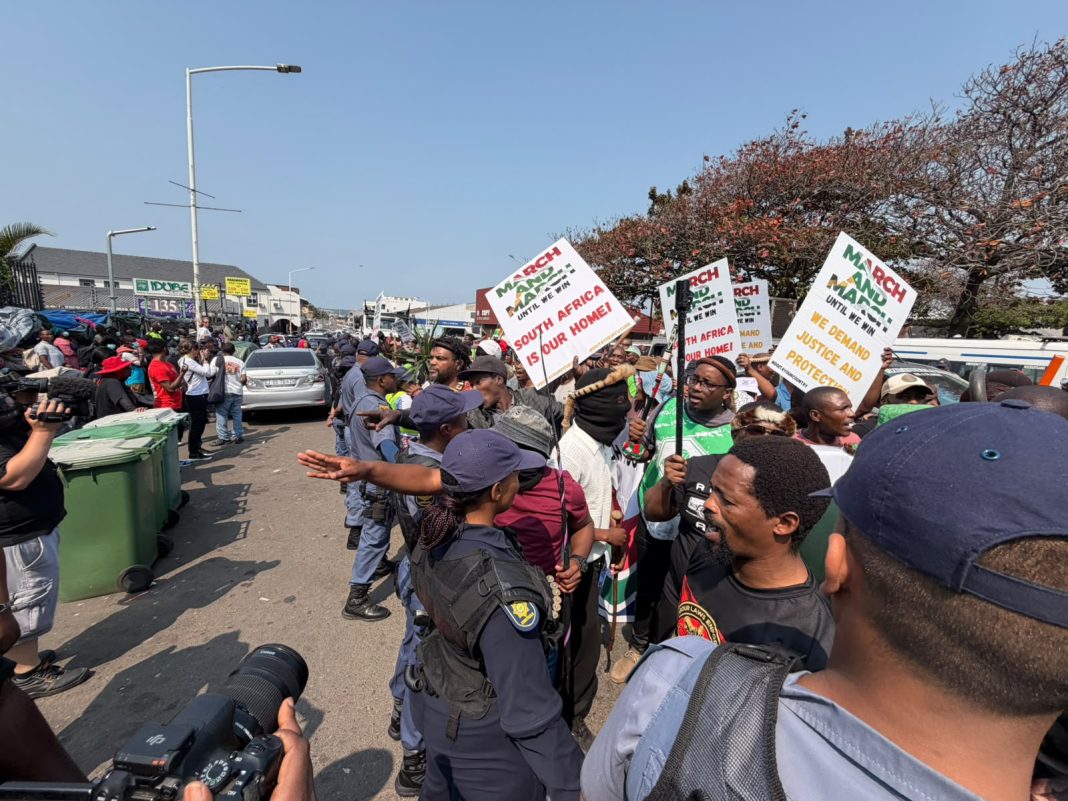
Anti-illegal immigration mobilisation surged across the country in 2026, with March and March and other groups staging demonstrations in several cities and towns and setting 30 June as a “deadline” for undocumented migrants to leave the country.
Police were placed on high alert as thousands of migrants sought to leave. SAPS spent at least R300 million on deployments while Home Affairs reported after the June deadline that about R341 million was spent on in immigration enforcement, deportation and repatriation costs.
President Cyril Ramaphosa also authorised the employment of 3,400 SANDF members from 28 June to 31 July to support police.
The 30 June protests were held in cities and towns across the country, several turning violent, and with threats and intimidation reported. Many businesses shut their doors as demonstrators demanded the deportation of undocumented foreign nationals. Acting Police Minister Firoz Cachalia said at the time that the protests appeared to be developing into a political campaign ahead of the local government elections.
The Commission commended the government for recognising the human rights concerns arising from the attacks, intimidation, discrimination and protests targeting foreign nationals.
It praised steps to counter vigilante activity, including condemnation of unauthorised documentation checks and attempts to block access to services, support for people forced to flee, and stronger proactive policing ahead of the June deadline.
It also commended “certain political parties”, including the Economic Freedom Fighters, for “debunking the attribution of responsibility for scarce resources and access to services, as well as social problems, to foreign nationals” and for condemning xenophobia and Afrophobia.
Non-encampment model welcomed
The Commission welcomed South Africa’s non-encampment model, which lets refugees and asylum seekers live within communities rather than in camps and allows them, and even undocumented migrants, to engage in some business activities. But it noted that the model concentrates migrants, mostly nationals of other African states, in informal settlements and marginalised neighbourhoods, leaving them most affected during periods of anti-migrant mobilisation.
It listed the 2023 Prevention and Combating of Hate Crimes and Hate Speech Act as a positive development, but said government needed to expedite the regulations needed to operationalise it.
It welcomed court judgments protecting the rights of non-nationals, including rulings securing access to courts and COVID-19 social grants for asylum seekers. It recommended that government ensure application of the Constitutional Court’s judgment in Scalabrini Centre v Minister of Home Affairs, which it said held that procedural non-compliance cannot bar asylum applications without an assessment of their merits, and reaffirmed the principle of non-refoulement.
The Commission raised concern about misinformation and disinformation about foreign nationals on social media, including about the scale and nature of intimidation, discrimination and xenophobic violence. It said South Africa lacked a legislative or policy framework to deal with the problem and recommended legislation covering different platforms.
Better implementation of action plan needed
It called for stronger implementation of the 2019 National Action Plan to Combat Racism, Racial Discrimination, Xenophobia and Related Intolerance, saying resources and sustained high-level political effort were inadequate. It also recommended public awareness measures on the difference between refugees, migrants and undocumented migrants, so that “all foreign nationals” are not classified as illegal immigrants.
It welcomed government’s five-point plan on migration and the establishment of the Inter-Ministerial Committee on Migration.
It recommended that adherence to human rights, dignity and non-discrimination be added as a stand-alone pillar of the plan, and that the South African Human Rights Commission (SAHRC) be represented in the committee’s deliberations and in the design and implementation of its measures.
The delegation also said responsibility for protecting the rights of undocumented migrants could not rest only with receiving states.
It said the African Union should launch a continent-wide initiative on undocumented migration, as a collective challenge for countries of origin and destination, and promote cooperation to expand regular, rights-based migration and improve the safe management of undocumented migrants.
It also said the AU should appoint a special envoy to promote ratification of free movement of peoples, which it said was critical to regional integration and implementation of the African Continental Free Trade Area.
The four-member delegation was led by Commissioner Solomon Ayele Dersso, the Commission’s rapporteur on the human rights situation in South Africa and chairperson of its Working Group on Extractive Industries, Environment and Human Rights Violations in Africa.
It also included Commissioner Ourveena Geereesha Topsy-Sonoo, Special Rapporteur on Freedom of Expression and Access to Information in Africa; Commissioner Dr Litha Musyimi-Ogana, chairperson of the Working Group on Indigenous Populations/Communities and Minorities in Africa and of the Committee on the Protection of the Rights of People Living with HIV and Those at Risk, Vulnerable to and Affected by HIV; and Commissioner Salma Sassi-Safer, Special Rapporteur on Refugees, Asylum Seekers, Internally Displaced Persons and Migrants in Africa.
The delegation met government ministers and senior officials, Parliament, the Public Protector, the SAHRC, Commission for Gender Equality, the Information Regulator, Legal Aid South Africa, United Nations representatives, civil society organisations and the media. It also visited the Emthonjeni Youth Centre and the Lindela Refugee Reception Facility.
The Commission said a comprehensive report on the mission would be prepared and tabled for consideration and adoption at one of its forthcoming sessions before being transmitted to the South African government.
INSIDE POLITICS






