

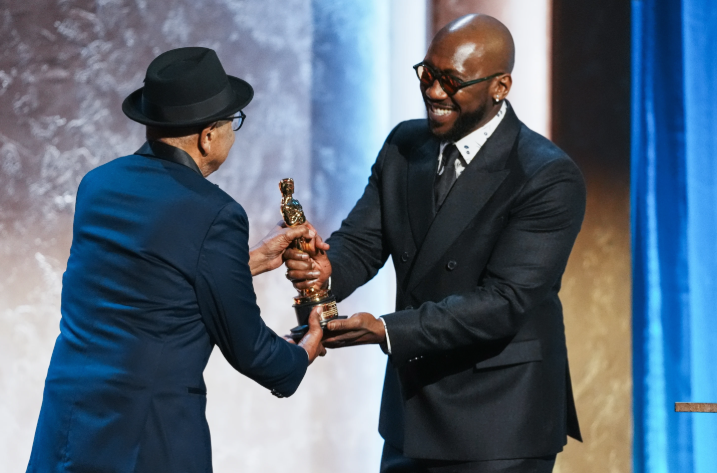


Floyd Norman said he was “Alice entering the gates of Wonderland” when he visited Walt Disney’s animation studio as a kid just out of high school.
Now 91, his joyful journey reached its peak Sunday night when he received an honorary Oscar for his decades of work as a groundbreaking animator. Holding up the statuette at the Governors Awards ceremony where he was honored alongside famous names like Glenn Close and Ridley Scott, with his wife and five children seated in front of him, he called it his “happy ending.”
Norman, who became the first Black animator at Disney when he went to work for the studio on “Sleeping Beauty” in 1956, spoke to The Associated Press during the run-up to the ceremony about what brought him to the moment.
“It’s the last thing I could ever have expected in a long, long career,” he said. “The Oscar, you don’t go beyond that. That is the ultimate.”
Norman grew up in Santa Barbara, California, and loved the movies.
“Even when I was a little kid, I knew I was going to work in film,” he said. With a very early proclivity for drawing, he set his sights on animation, with a love for Disney shorts and “Dumbo.”
“I fell in love with the medium,” he said. “I loved the idea that you can move drawings, that drawings can walk and talk and come to life.”
Just after high school, he took his work, unannounced and uninvited, to the Disney studio in Burbank on a Saturday when it was nearly empty.
But an animator who was there looked at his work, gave him encouragement, and suggested he go to Art Center, the college then in Los Angeles before it moved to Pasadena, where Norman now lives.
He got in the door at Disney working on “Sleeping Beauty” as an apprentice in-betweener, creating the transitional drawings between primary images.
He laughs as he remembers the extremely junior sounding title.
“That’s how everybody started,” he said. “Disney was a well-oiled machine. They had put together this system of making animated cartoons. That’s how you learned your craft. A lot of artists quit.”
He said many of the veterans in their 60s and 70s who worked on the films he loved as a child were still there, and were very generous mentors. He counts Walt Disney himself among them, calling him in his acceptance speech the “best mentor a filmmaker could ever have.”
But it would take 10 years before he had direct interaction with Disney.
Norman worked on “101 Dalmatians,” “The Sword in the Stone” and “Mary Poppins,” moving up incrementally to more important jobs.
Asked how he felt he was treated as the first Black animator in the building, he laughed and said he has been asked that question about his work more than any other for 50 years.
“The answer may surprise you,” he said. “It made no difference whatsoever.”
Disney himself would eventually notice comic drawings Norman did to entertain office mates, and assigned him to the story department to do the visual plotting on “The Jungle Book.”
“I would say that’s the most significant film that I worked on,” Norman said. “Because that was the only time I worked with Walt Disney.”
It would be Disney’s final film. He died in 1966, nearly a year before the release of “The Jungle Book.”
Soon after he and some partners would start their own company, Vignette Films, that produced segments for “Sesame Street” and for Saturday morning cartoons, and created the animated intro for the dance series “Soul Train.”
He would work all over the animation world with his own company and with others including Hanna-Barbera in the 1970s and 1980s.
He returned to Disney to work on 1996’s “The Hunchback of Notre Dame.” The film gave him his first onscreen credit, which had been harder to come by in the 60s. He also worked on “Mulan.”
Pixar then invited him to work on “Toy Story 2” and “Monsters, Inc.”
Pete Docter, director of “Monsters, Inc.” and a Pixar stalwart, said in a video shown at the ceremony that they were having problems with story elements when he saw Norman’s “gorgeous” storyboards and brought him on to help solve them.
Norman said that while the technology was miles ahead of what he had known in his early days, the job of an animator was essentially still the same.
“It didn’t feel any different,” he said. “A movie’s a movie. The story’s the story.”
AP






