



By Associated Press
Six months after an Ebola outbreak was declared in the Democratic Republic of Congo (DRC), the disease remains out of control, with more than 11,000 cases recorded and nearly half of those infected having died.
According to government data, the outbreak is the deadliest of the country’s 17 recorded outbreaks and could surpass the death toll of the West African epidemic, which killed approximately 11,000 people between 2014 and 2016.
Basic containment measures, including contact tracing and isolation, remain inadequate, raising concerns about the government’s ability to contain the outbreak.
Health experts warn that bringing the disease under control within the next year is unlikely.
By the time the outbreak was declared in mid-May, 43 deaths had already been recorded, suggesting the virus had circulated undetected for some time.
It has since spread to eight of the country’s 26 provinces, at a pace humanitarian organisations have compared to wildfire.
New hotspots continue to emerge, placing further pressure on an already overstretched healthcare system.
Questions over funding and management
Community transmission remains high, with the Africa Centres for Disease Control and Prevention (Africa CDC) reporting that 80% of new cases are being detected outside established health surveillance systems.
This suggests that most infections are not being identified through contact tracing or routine monitoring.
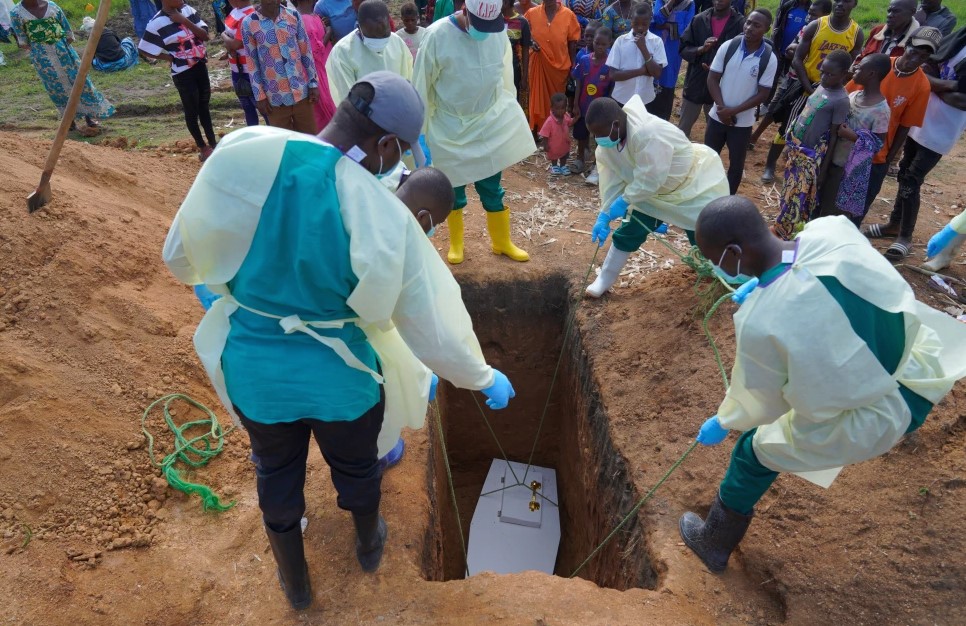
About one-third of deaths occur at home or elsewhere in communities, where burials and other procedures are often conducted without specialist supervision, increasing the risk of further transmission.
The response has also been disrupted by repeated strikes among healthcare workers over salaries that have reportedly gone unpaid for months.
In some cases, patients with confirmed Ebola infections have been left without treatment.
Humanitarian organisations have raised concerns about the management of funding allocated to the outbreak response.
Last month, the Africa CDC questioned the accounting for more than $700 million in Ebola-related assistance.
“A troubling disconnect between the considerable resources mobilised for the response and what is actually reaching patients, frontline workers, and communities continues,” said Médecins Sans Frontières (MSF), also known as Doctors Without Borders.
Children face particularly high death rates
Children are among those most vulnerable to Ebola, particularly those with underlying health conditions such as malnutrition.
Health experts say many infected children have not received specialised medical care, contributing to exceptionally high mortality rates.
According to UNICEF, children accounted for 35% of all Ebola deaths recorded up to 4 November.
Children younger than five accounted for 21% of all deaths, while nearly 72% of infected children in this age group have died.
Armed conflict and attacks hamper response
Healthcare workers face increasingly dangerous conditions as efforts to contain the virus encounter resistance linked to social and cultural practices.
Since the outbreak began, healthcare workers have been attacked, some fatally, while health facilities have also been targeted.
The outbreak has been concentrated in eastern Congo, particularly in Ituri and North Kivu provinces, where communities are already struggling with armed conflict and displacement.
Fighting between government forces and numerous armed groups, including the Rwanda-backed M23 rebel movement, has contributed to one of the world’s most severe humanitarian crises.
The Allied Democratic Forces (ADF), an armed group affiliated with Islamic State, has also carried out attacks against civilians.
The combination of insecurity, damaged healthcare infrastructure and displacement has complicated efforts to identify infections, isolate patients and prevent further transmission.
The rapid spread of Ebola has also raised concerns about transmission beyond Congo’s borders.
Nigeria, Kenya and Uganda have confirmed cases, making this the most geographically widespread Ebola outbreak on record.
INSIDE POLITICS






