



By Charmaine Ndlela
The Export Credit Insurance Corporation (ECIC) has unlocked R1.06 trillion in capital for projects across key economic sectors over the past 25 years, supporting the creation of more than 87 000 jobs and contributing R21.7 billion to South Africa’s gross domestic product (GDP).
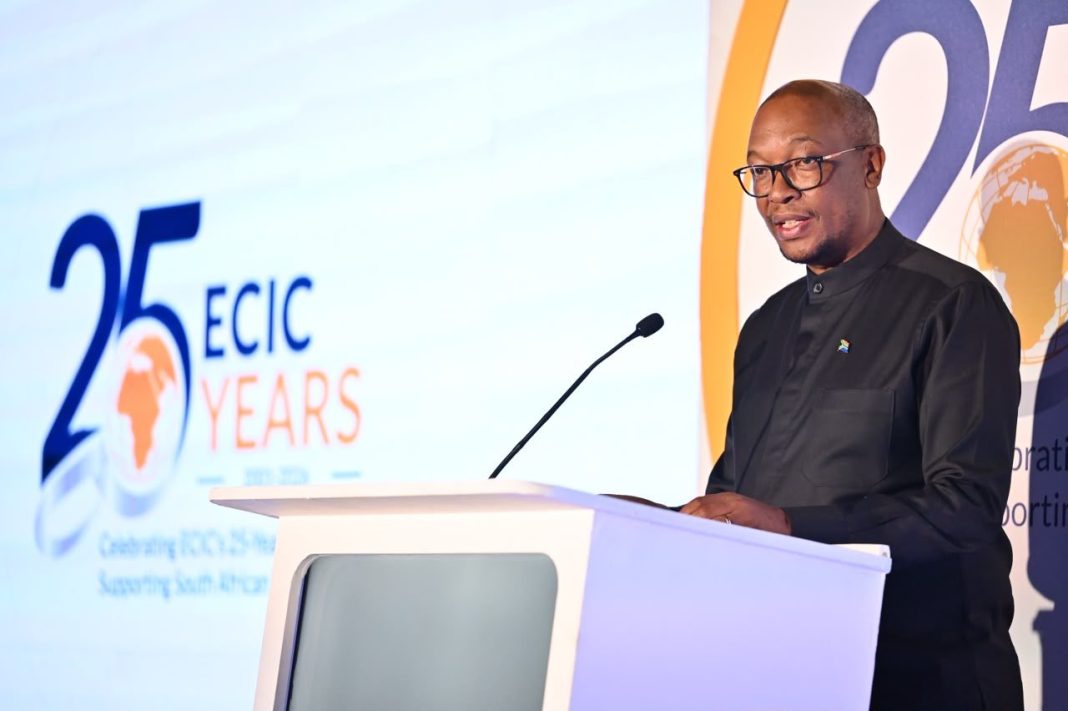
Minister of Trade, Industry and Competition Parks Tau revealed the figures during the ECIC’s 25th anniversary celebration in Sandton, Gauteng, where government leaders, exporters, financial institutions and industry stakeholders gathered to reflect on the institution’s contribution to South Africa’s export development and industrialisation.
Established in 2001, the ECIC is a state-owned export credit agency that provides insurance against political and commercial risks associated with international trade and investment. It helps South African exporters and financial institutions manage risks such as non-payment, political instability and restrictions on transferring funds, making it easier for local businesses to secure financing and pursue opportunities in foreign markets.
Tau said the corporation had played a significant role in mobilising capital for projects in rail, mining, power, manufacturing and telecommunications, while helping South African companies expand beyond the country’s borders.
The institution has also contributed approximately R7.9 billion in tax revenue, with its current portfolio valued at R33.2 billion.
“The current portfolio value of the Corporation is now sitting at R33.2 billion. Notable supported projects include MTN in Nigeria, Vodacom in Tanzania, the Konkola Copper Mines in Zambia and gold mines in Tanzania,” Tau said.
“Sasol’s natural gas pipeline from Mozambique, the Cenpower project in Ghana and the Maputo Port expansion and the Nacala Rail Corridor. Each one carried South African engineering, construction and services into new markets.”
Tau said these investments demonstrated the importance of export credit insurance in helping South African businesses compete internationally, particularly in markets where commercial financing was difficult to secure.
However, with global trade patterns shifting and geopolitical risks increasing, Tau said the ECIC needed to diversify its exposure and expand into new markets.
He outlined the corporation’s butterfly trade strategy, which seeks to reduce its dependence on a limited number of countries and broaden its international reach.
According to Tau, 88% of the ECIC’s current exposure is concentrated in just three countries, making geographical diversification a priority.
“The ECIC intends to expand its footprint across the Atlantic and Indian Oceans while deepening involvement within the African continent through the African Continental Free Trade Area (AfCFTA) and its Class A membership of Afreximbank to expand trade finance for AfCFTA transactions,” he said.
Tau said strengthening South Africa’s participation in continental trade would require institutions capable of mobilising financing and managing risks associated with cross-border investments.
He also emphasised the importance of attracting private-sector investment rather than relying exclusively on government funding to finance export opportunities.
“Capital must follow the opportunity. Plans do not build factories and trade agreements do not finance exports. Capital does. Government should not replace commercial finance. ECIC’s role is to share and absorb risk so private capital can participate,” Tau said.
He said the government was advancing plans to establish a South African Export-Import Bank to address financing gaps and strengthen support for exporters.
“That is why government is advancing work towards a South African Export-Import Bank. It will not compete with commercial banks. It will fill the gaps the market cannot, through credit lines, guarantees and risk-sharing that crowd in commercial lending,” he said.
The proposed bank would complement existing commercial financing by providing credit lines, guarantees and risk-sharing mechanisms to help businesses pursue export opportunities that might otherwise struggle to attract funding.
Tau also placed transformation at the centre of South Africa’s export ambitions, saying the country’s export future could not depend solely on large corporations and established businesses.
He said the ECIC’s expansion into short-term export credit insurance would help small and medium-sized enterprises (SMEs), black industrialists and emerging manufacturers access international markets.
The expansion is intended to broaden participation in export-led industrialisation and ensure smaller businesses can benefit from international trade opportunities.
“The ECIC is committed to continue supporting black-owned companies in the rail sector, and to drive transformation through its investment activities,” Tau said.
He added that the government remained committed to protecting existing export markets while creating new opportunities for South African businesses, particularly those facing uncertainty in traditional trading destinations.
“And to South African exporters, especially those facing uncertainty in traditional markets, government stands with you,” Tau said.
“We will defend important markets, open new ones, deepen regional value chains and strengthen the institutions that put capital behind our industrial ambitions.”
INSIDE POLITICS






