
- Advertisement -spot_img

Fadiel Adams admits he was in contact with Brown Mogotsi when he opened cases against Crime Intelligence senior officials

- Advertisement -spot_img

Must read

By Johnathan Paoli

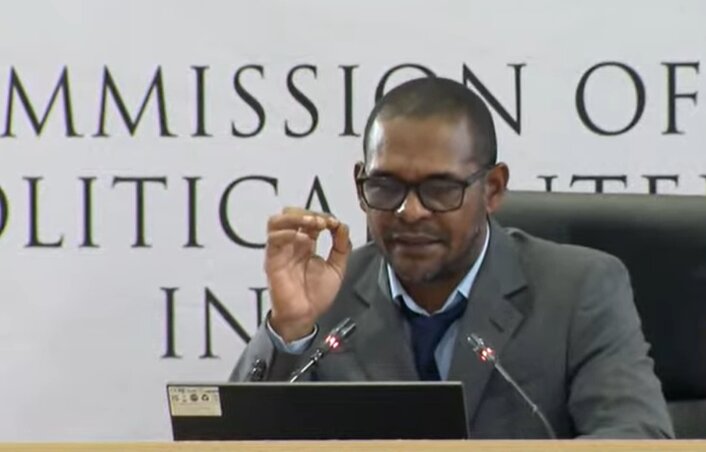
Suspended National Coloured Congress MP Fadiel Adams has admitted that he communicated with alleged political fixer Brown Mogotsi during December 2024 when he opened cases against senior South African Police Service (SAPS) officials

Appearing for his second day of testimony before the Madlanga Commission of Inquiry on Thursday, Adams faced intense questioning over his dealings with crime intelligence-linked figures and his handling of information contained in dockets he claimed had been left on his office floor.

Adams initially appeared uncertain about his contact with Mogotsi when commissioner Sandile Khumalo asked whether he had communicated with him before opening a second set of criminal cases against crime intelligence in Johannesburg.

He eventually acknowledged that he had spoken to Mogotsi at the home of late Major-General Andre Lincoln, although he maintained that the conversation took place after he had opened the second set of cases.

Adams said the discussion concerned Lincoln’s alleged failure to receive his pension.

The admission came as the commission confronted Adams with evidence from a previous witness, Witness G, who has been described as Mogotsi’s alleged crime intelligence “handler”.

Witness G testified that he knew Adams from his days as an activist and that Adams had contacted him for assistance in opening a case at Orlando police station in Soweto.

Adams confirmed that he had called Witness G, whom he referred to as “Elvis”, but disputed the witness’s version of events.

“I called him. I did call him, but I think he’s got his details wrong,” Adams said.

He maintained that he was the one who told Witness G that he would be coming to Orlando, rather than the witness arranging for him to meet there.

The commission also questioned why Adams had chosen Orlando to open the second set of cases when he had landed at OR Tambo International Airport and could have opened them closer to Kempton Park.

Evidence leader Lee Segeels-Ncube highlighted what she described as the troubling coincidence that the person who assisted Adams at Orlando was linked to crime intelligence, was a friend of suspended Crime Intelligence deputy head Major-General Feroz Khan and was allegedly associated with Mogotsi.

Adams denied having any relationship with Khan, saying he had only seen him at a dinner.

The questioning also exposed Adams’ continuing difficulty in explaining the origins and contents of information that prompted him to lay charges against crime intelligence officials.

Adams has previously said documents were delivered under his door and that these documents prompted him to open cases.

But when shown documents during the commission’s proceedings, he appeared confused about which material he had actually handed over to authorities.

He also acknowledged that much of the information he relied on came from Lincoln, but only disclosed this after Lincoln’s death in May 2025.

Adams said he would not have identified Lincoln as his source while he was alive.

The commission repeatedly challenged Adams over his reliance on Lincoln’s account that his dockets had been intercepted.

“You cannot rely on a dead man every time. It’s unacceptable,” Segeels-Ncube said.

Adams conceded that he may have worded his complaint to suspended police minister Senzo Mchunu poorly, after he told Mchunu that the Gauteng dockets had been intercepted when, according to the commission, he had only been told they were about to be intercepted.

Commissioner Sesi Baloyi said the overall sequence of events “stinks of machinations”, pointing to the documents delivered under Adams’ door, his subsequent criminal complaints, his contact with Witness G, his immediate escalation to Mchunu and the eventual referral of the matter to the Investigating Directorate for Anti-Corruption.

“There’s just something wrong about this whole process. For lack of a better word, it stinks of machinations,” Baloyi said.

Adams conceded that, when the events were viewed together, “it does stink”, but insisted that his only motivation had been to have the allegations investigated.

The commission also challenged Adams over his attacks on suspended national commissioner Fannie Masemola.

Adams said Masemola had assured Parliament’s police portfolio committee that crime intelligence analysis and coordination head Major-General Nozipho Madondo’s security clearance was above board.

Adams nevertheless maintained that he feared a police cover-up and therefore resisted attempts by the Police Inspectorate to interview him about his complaints.

Madlanga directly challenged that explanation, saying Adams was struggling to explain his conduct and accusing him of not being truthful about his interaction with Colonel Phillips.

“No, you are not being truthful, Mr. Adams, you are not. Bear in mind that the very previous day. You have complained to the minister. Why is it that you cannot think, oh, there’s immediate movement? The minister is moving on this. No, you’re not being truthful,” Madlanga said.

The exchanges left Adams facing sustained scrutiny over shifting versions of events.

The commission’s questioning has increasingly focused not only on whether Adams’ allegations were correct, but on how he obtained, interpreted and escalated the information on which he based them.

The commission continues.

INSIDE POLITICS

More articles

LEAVE A REPLY

Please enter your comment!
Please enter your name here

Inside Education E-edition June 2026

spot_img

Services Seta 2026

spot_img

CATHSSETTA

spot_img

AVBOB STEP 12

spot_img

Inside Metros G20 COJ Edition

spot_img

JOZI MY JOZI

spot_img

QCTO

spot_img

Latest article



