By Johnathan Paoli
Independent Directorate Against Corruption (IDAC) investigator Mantsha Raphesu has revealed that the investigation into senior Crime Intelligence (CI) officials began under unusual circumstances, with key investigators allegedly knowing about the probe in advance, internal disputes over who would lead it, and senior managers being kept in the dark.
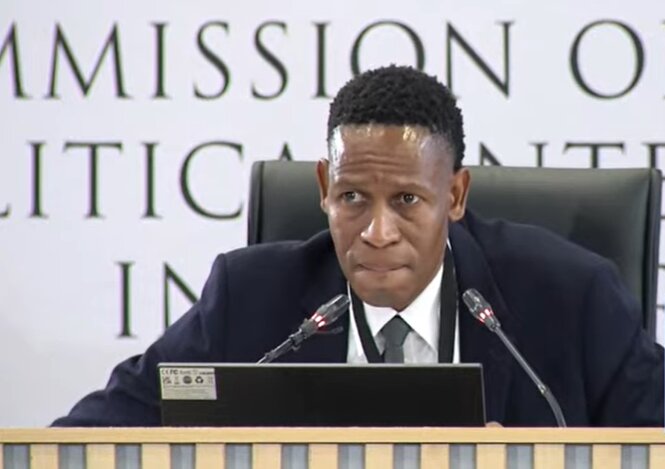
Testifying before the Madlanga Commission of Inquiry on Friday, Raphesu said he had worked on the CI CFO Major-General Philani Lushaba house breaking and robbery case, the appointment of CI Technical Support Services head Brigadier Dineo Mokwele investigation and had been involved in ‘Operation Diversion’.
Following the referral by National Coloured Congress MP Fadiel Adams into corruption, fraud and nepotism in the CI leadership, the IDAC investigator described an environment where investigators attempted to verify allegations beyond the contents of the referral, despite concerns over the limited information initially available.
Raphesu said prosecutor Drushantha Ramsamy handed him the classified referral on 6 December 2024, making it clear he was only expected to glance through it briefly before it was locked away in former IDAC head Andrea Johnson’s safe.
Raphesu recalled that the affidavit focused primarily on allegations involving the Political Killings Task Team (PKTT), including claims about accommodation, laundry expenses of about R400,000, the purchase of luxury vehicles using secret-service funds, alleged property acquisitions in Gauteng and KwaZulu-Natal, and claims of a cover-up involving senior police officials.
Raphesu described a trip to Cape Town where he, Ramsamy and Perumal interviewed Adams and commissioned four supplementary affidavits intended to clarify the contents of the original referral.
“I expected that Mr Adams would explain the documents and provide substantive facts. We got nothing new,” Raphesu said.
The commission previously heard that a now provisionally withdrawn case against CI head Lieutenant-General Dumisani Khumalo and others were made for what was described as a dodgy appointment of Mokwele as head of CI’s Technical Support Services.
Raphesu said he refused to continue as lead investigator because investigative protocols were ignored.
He said Perumal and investigator Brian Padayachee met witnesses privately at hotels without informing him, later returning with affidavits for him to process.
“It was not permissible for them to identify someone and interview them without my knowledge. It was wrong,” Raphesu said.
He said he reported the conduct to Ramsamy and IDAC head of operations Mathews Sesoko before requesting to be removed from the Mokwele investigation.
Turning to the Lushaba investigation, Raphesu said he became concerned when he was instructed to prepare a Section 28 application seeking Lushaba’s banking records.
According to allegations, Lushaba had been a victim of a robbery in which a CI laptop had been stolen by a sex worker, and that slush funds had been used to pay off the woman and replace the laptop.
The IDAC investigator testified that Johnson instructed Ramsamy to have him draft the Section 28 documentation, but he objected because he believed investigators lacked sufficient information to justify such a subpoena.
Raphesu said he initially sent a strongly worded message urging that the Section 28 process be delayed until further consultation with Adams had taken place.
He said Johnson did not receive the message favourably and instructed that the application be drafted immediately despite his reservations.
Raphesu further testified that the information underpinning the proposed subpoena consisted only of a piece of paper containing details about Lushaba and that investigators had not established where the information originated.
The commission also heard evidence of internal conflict surrounding who would lead the investigation.
Raphesu said that senior investigator Suneel Bellochun openly clashed with chief investigator Dylan Perumal after Bellochun was not appointed lead investigator on the Adams referral.
According to Raphesu, the confrontation suggested Bellochun, who was absent from the briefing, already knew about Adams’ classified referral before the official briefing took place.
The commission also examined evidence relating to forensic examiner Paul O’Sullivan.
The IDAC investigator disputed claims that O’Sullivan had no involvement in the Mokwele investigation, saying emails showed O’Sullivan communicated directly with former Johnson and that he himself later consulted with the activist.
Raphesu said that Perumal instructed him to interview O’Sullivan after a video emerged in which O’Sullivan referred to “the BMW lady”, an apparent reference to Mokwele.
He said he subsequently contacted O’Sullivan, who emailed him several documents, including a report, correspondence and information relating to Mokwele.
Upon reviewing the emails, however, Raphesu discovered that Johnson had already received exactly the same material.
That evidence directly contradicted Johnson’s earlier testimony before the commission, where she had stated that although O’Sullivan might have communicated with other IDAC officials, he had not communicated with her or supplied information relating to Mokwele.
But, the IDAC investigator said he felt the impact of “asking too many questions”, receiving notice of disciplinary hearings being instituted against him for allegedly making a call to an unknown individual and “leaking information”.
Raphesu further testified that he has been barred from investigating matters involving the security cluster, while maintaining that many of the concerns he raised about Operation Diversion remain unresolved.
He said he has since lodged a grievance over the disciplinary proceedings instituted against him, which have made no progress, and intends opening criminal cases against several individuals, including Perumal and Padayachee.
The commission concluded proceedings for the day, with the next witness to appear before the commission on Tuesday morning.
INSIDE POLITICS