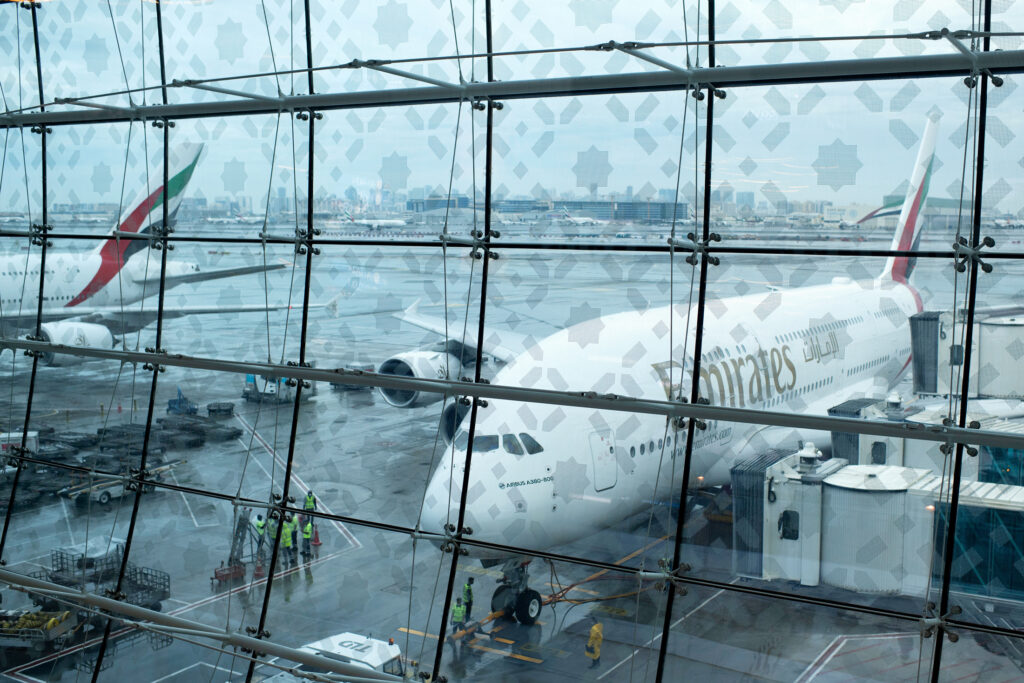


Thousands of flights have been disrupted in the wake of the escalating conflict engulfing the Middle East, with Dubai’s main airport — the world’s busiest aviation hub — effectively shut down in light of airspace closures and after it was hit by a suspected aerial strike.
There have been more than 2 300 flight cancellations in the region, from Bahrain to Tel Aviv, in the past day, with more than 90% of departures from Dubai International Airport being scrapped, according to FlightAware data.
Middle Eastern airlines were severely disrupted as of Sunday morning, with Emirates canceling 87% of its scheduled flights and FlyDubai canceling 89%. The cancellation rate at Etihad, Gulf Air and Qatar Airways were 67%, 79% and 36% respectively, according to the data.
Hundreds of thousands of people have been stranded as the region functions as a global superconnector, linking any two points on the planet with one single stop in airports like Dubai, Doha or Abu Dhabi.
That’s helped carriers including Emirates, Qatar Airways and Etihad to create massive fleets that funnel passengers through their hubs, turning the Middle East into a vital artery for global air-traffic flows.
Unprecedented scale
Though the Persian Gulf has become accustomed to disruptions as the skies over large swaths of the Middle East suffered restrictions several times during the past two years, an outright suspension for many hours on a massive regional scale is unprecedented, highlighting the stakes in the conflict that’s pitting Iran against Israel and the US.
Emirates extended flight cancellations into Sunday morning, while Qatar Airways said operations are suspended until further notice, with updates planned for later.
Emirates and Qatar Airways operate multiple flights from South Africa’s three main international air hubs — OR Tambo International Airport (Johannesburg), Cape Town International and King Shaka International in Durban. South African passengers and tourists to the country are likely to also be severely impacted by the situation, as Middle Eastern carriers handle a major share of air passenger traffic to and from the country.
The Airports Company South Africa (Acsa) also posted a brief update on the situation, saying affected travellers need to contact their respective airlines directly.
The Emirates website still shows that flights are suspended on its travel updates link.
Etihad Airways said on Saturday that it will maintain the suspension at least until Sunday afternoon.
Elsewhere, India’s civil aviation authority said that local carriers canceled 410 flights on Saturday and 444 are expected to be canceled on Sunday.
With major Middle East Airports unable to give a definitive timeline of when they will resume operations, travel uncertainty is set to grow across the globe.
Dubai Airport damaged after strike
Dubai International was partially damaged by the suspected aerial strike on one of its main terminal buildings, marking another escalation after air traffic in the Persian Gulf closed down hours after Iran’s retaliatory attacks.
The airport operator confirmed that one concourse at Dubai International “sustained minor damage in an incident, which was quickly contained,” and that four employees sustained injuries, according to a statement.
Footage shared on social media showed a thin plume of smoke rising from one of the main departure buildings, with emergency and fire services on the tarmac.
Another video from inside the building appeared to show some damage, though the overall structure was broadly intact.
The strike highlights just how deep Iran’s retaliatory campaign against the initial attack by US and Israeli forces has advanced into the Persian Gulf, where authorities were forced to respond to a barrage of missile and drone attacks by closing the airspace.
The fallout was most immediate at the main airports in the region, where tens of thousands of travelers were left stranded as airspaces closed down, forcing Emirates, Qatar Airways, Etihad Airways and other carriers to halt all operations.
At Dubai International Airport, arrivals and departure boards in the terminals initially showed major delays that quickly cascaded into a full suspension, a disruption on a scale not seen in decades.
Emirates has long prided itself in its clockwork operations, even in times of crisis — be it the pandemic or regional strife. But this time, interrupting all services was the only possible response.
Disruptions at airports in the region weren’t limited to cancellations. Kuwait’s civil aviation authority said a drone hit the country’s airport, causing several light injuries and “limited” damages to the passenger building.
Airlines have been forced to cancel flights on profitable routes, spend more on jet fuel and pass through countries they usually avoid — like Afghanistan — as they avoid dangerous airspace.
Dubai is the world’s busiest international airport, handling more than 2 000 daily flights by more than 100 airlines that operate at the hub. Emirates is the flagship operator, with a fleet of long-haul Boeing Co. and Airbus SE aircraft that fly to more than 140 destinations worldwide.
The facility is usually able to clear the thousands of passengers that flow through the airport in a matter of minutes, using advanced technology including face-recognition.
On Saturday, check-in halls quickly filled up with stranded travellers. Electronic smart gates were closed off, leading to longer lines as people crowded immigration desks.
Lines snaked through the departure area of the airport, while others rushed to the exits in search of taxis back into town. Many sought to receive hotel vouchers that the airlines had promised.
Some passengers were initially hopeful that they would able to make their flight, but around 4 pm all operations came to a halt, and thousands of people were told to leave the airport.
Other passengers believed that they had gotten out just in time, only to see their flights turn back because the air space they were traversing had become too dangerous.
An Emirates Airbus A380 superjumbo bound for San Francisco turned back to its base in Dubai, and other aircraft were also left out of position, adding to the chaos on the ground.
At Doha airport, which handles about a 1000 flights a day, similar scenes unfolded, reminiscent of the situation last year in June, when scattered Iranian strikes on Qatar left 20 000 travellers temporarily stranded.
“People are very tired and very nervous, some have no idea what’s coming next and for how long we are stuck,” said Tarun Pathak, who was traveling from New Delhi to via Doha to Barcelona on a business trip.
BLOOMBERG