
By Johnathan Paoli
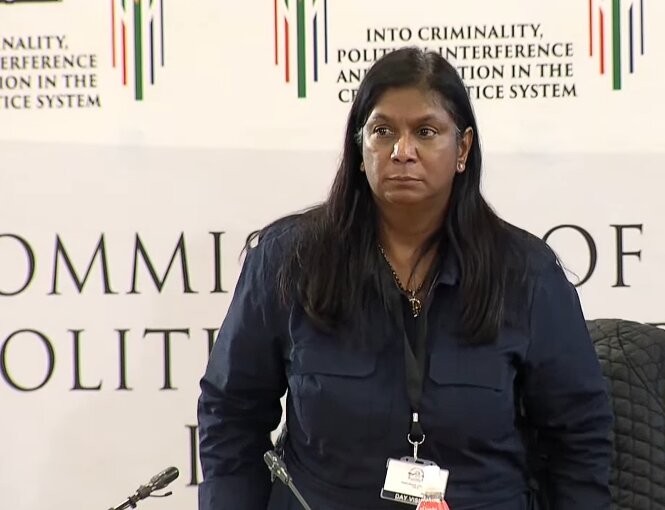
Investigating Directorate Against Corruption (IDAC) head Andrea Johnson has apologised for describing Crime Intelligence (CI) Technical Support Services head Brigadier Dineo Mokwele’s appointment as a “token appointment”, conceding that she had never read Mokwele’s curriculum vitae, job application or the advertisement for the position.
Resuming her testimony before the Madlanga Commission of Inquiry on Thursday, Johnson apologised after sustained questioning by commissioners and evidence leader Mahlape Sello over the factual basis for her allegations that Mokwele was unqualified for the post and had been appointed for ulterior motives.
“I would have to go further than to withdraw. I would have to apologise if that statement was made. I base it on what I was given, but I accept, having gone through this file, that the word unsuitable is unsuitable and that the word token is wholly inappropriate,” Johnson said.
Commissioner Sandile Khumalo questioned why Johnson had testified under oath that Mokwele lacked the necessary qualifications when she had not familiarised herself with the documents relating to the appointment.
He said the impression initially created was that Crime Intelligence had appointed “a receptionist from BMW”, but the official records presented a very different picture.
“I must say this to you. Before I saw these files, the picture painted in my head was that Crime Intelligence appointed a receptionist from BMW. That’s the picture I had in my head. Until I saw these files, then it became clear to me that this person is not just qualified, but her qualification exceeds the requirements,” Khumalo said.
He pointed to Mokwele’s degree in industrial engineering and mechatronics, her strong matric results and about 12 additional certificates, including qualifications in cybersecurity, arguing that her credentials exceeded those required for the Section Head: Technical Support Services position.
After being referred to the job advertisement, Johnson acknowledged that her earlier assertions were incorrect.
Khumalo then pressed Johnson on how she could have recommended fraud charges without reviewing Mokwele’s application.
When asked whether she knew Mokwele had disclosed that she was studying towards a Master of Business Administration, Johnson replied that she had not read the application.
“Now, if you have not seen her application for this job, how can you make a recommendation as you did in your prosecution memo that she must be charged with fraud and many other things? What fraud has she committed?” Khumalo asked.
Johnson said she had relied entirely on information provided by her investigators.
The commission then returned to Johnson’s previous description of Mokwele’s appointment as a “token appointment”.
“You described Ms Mokwele’s appointment as a token appointment. It’s an unfair statement to make, having not seen her CV, having not seen her qualifications. Can you please in this commission withdraw the statement that her appointment is a token appointment? It is an insulting thing to say,” Khumalo said.
Johnson said she had never intended to disparage or tarnish Mokwele’s reputation and was only concerned with possible fraud or corruption.
The exchange formed part of broader criticism by the commission of IDAC’s investigation into Mokwele’s appointment.
Commissioners questioned why IDAC had pursued criminal charges over an appointment process governed by SAPS internal policies and whether the directorate had exceeded its statutory mandate.
Sello also questioned whether IDAC had improperly used its preliminary investigation powers under Section 28 of the National Prosecuting Authority Act to conduct what amounted to a full investigation before formally authorising one.
Commissioner Sesi Baloyi reiterated her earlier observation that the original Section 27 referral submitted by National Coloured Congress MP Fadiel Adams contained suspicions rather than facts, suggesting IDAC embarked on a “fishing expedition” to establish jurisdiction after the fact.
Johnson accepted several of the commission’s criticisms, conceding that the investigation would need to be revisited in light of the legal and factual issues raised during her testimony.
“If there’s a wrong decision, that must be corrected,” she said.
Johnson said she would prepare a report for National Director of Public Prosecutions Andy Mothibi so that ongoing reviews of the cases could take the commission’s findings into account.
Meanwhile, Public Interest SA announced on Thursday that it had lodged a formal complaint with the Legal Practice Council seeking a disciplinary investigation into Johnson’s conduct.
The organisation said the complaint was based on what it described as Johnson’s “damning concessions” before the commission, arguing they raised serious questions about her fitness to practise as a legal practitioner and to continue leading IDAC.
Public Interest SA also called on Mothibi to urgently consider whether prosecutions arising from the Crime Intelligence investigations remained constitutionally sustainable. It further requested that the State Security Agency review Johnson’s security clearance and urged her immediate suspension pending the outcome of investigations.
The commission adjourned for the day, with Johnson expected to resume her testimony on Monday morning.
The commission will also rule on Friday morning on whether controversial businessman Suliman Carrim’s application for a postponement should be heard in camera.
INSIDE POLITICS





