
- Advertisement -spot_img

Leftists push unity agenda as SACP conference heads into final day

- Advertisement -spot_img

Must read

By Lebone Rodah Mosima

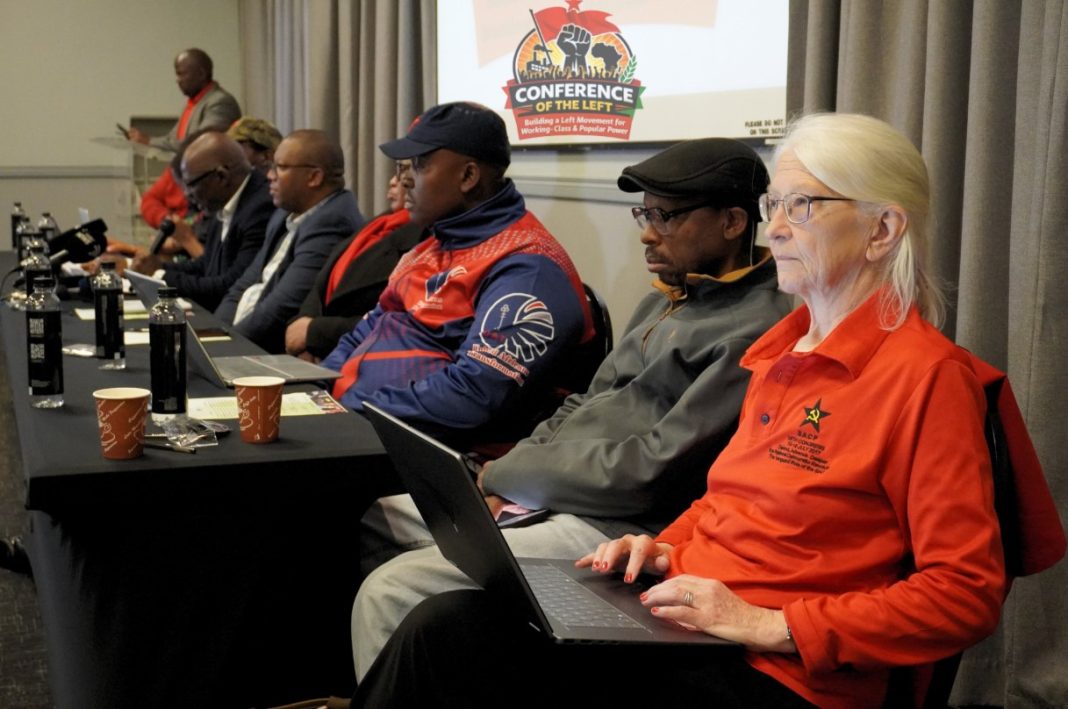
Left-wing political parties and organisations are heading into the final day of the Conference of the Left on Sunday, with speakers having called for a united front against poverty, inequality, neo-colonialism, and the Government of National Unity (GNU).

The three-day conference, convened by the South African Communist Party (SACP) at the Birchwood Hotel in Boksburg, has brought together political parties, trade unions, civic organisations and other left formations as the SACP seeks to build a coordinated platform outside the traditional boundaries of the ANC-led alliance.

The SACP has said the aim is to strengthen “coordination, unity in action, political education and organised struggle among diverse left, working-class and popular formations”.

Political parties represented at the conference include the Economic Freedom Fighters (EFF), Socialist Party of Azania (SOPA), uMkhonto weSizwe Party (MKP), Pan Africanist Congress of Azania (PAC), Azanian People’s Organisation (AZAPO), United Africans Transformation (UAT), Workers’ Socialist Party and Afrika Mayibuye Movement.

The gathering comes amid deepening tensions between the ANC and the SACP after the ANC stayed away from the conference, dismissing it as a gathering that did not represent the left. The SACP has rejected that criticism and says the conference is intended to build working-class unity, not create a new political party.

PAC secretary for finance Jackie Seroke told delegates that South Africa’s democratic order had failed to resolve the structural poverty and dispossession inherited from colonialism and apartheid.

He said South Africa’s constitutional democracy should be understood in the context of what PAC founder Robert Sobukwe described as a “colossal fraud”, referring to the 1909 Act of Union.

Seroke said the conference should articulate the aspirations of the African majority and define the transformation sought by the PAC against “imperialism” and “settler colonialism”.

“Imperialism is the one that allows this government or regimes or leadership that runs these countries not to do as the people wish,” he said.

He said struggles against settler colonialism and “neo-colonialism” had to confront political and economic systems in Africa and South Africa that, in his view, served imperial interests rather than the needs of ordinary people.

“We should be united against this force until such time that the Palestinian people are free. This means Africa itself must also be free. New colonial Africa has held us back,” he said.

“Africa has the majority of young people, and young people must be properly educated and political to fight against settler colonialism and neo-colonialism.”

Seroke said unity among oppressed people was essential if left formations were to build a credible alternative.

“We say that to define settler colonialism is to define imperialism. Imperialism is a common enemy of all oppressed people.”

Afrika Mayibuye Movement first deputy president Thato Wa Magogodi said the conference should not become a platform for political egos or symbolic identity politics, but should focus on practical left-wing solutions to the problems facing poor and working-class communities.

He said the cost-of-living crisis had moved beyond political theory and was being felt directly by households.

“In 2026, the cost of living in South Africa is not an academic graph. It is a throat being squeezed,” he said.

Magogodi spoke about the rising cost of paraffin, mealie-meal and taxi fares, saying these consumed a significant portion of workers’ wages while poor communities remained exposed to “unfair economic pressure”.

He said the left had to unite around practical measures to alleviate poverty, politicise the masses towards socialism and build a platform capable of advancing a more radical programme.

Magogodi said a multipolar world did not automatically mean a more just world, warning that capitalism could survive under several centres of power.

“The reality is that a few other poles – can still be many carts pulling the same wagon of capitalism underpinned by the same imbalance of power between the owners of the means of production and those who own only their labour but are still poor,” he said.

“Our task here in South Africa and everywhere else in the world is to commit these new poles to a credible, sustainable left agenda – one that will bend the shift in power towards the worker, the landless, and the structurally excluded.”

He said the task of the conference was to help build a revolutionary centre rooted in “total freedom and emancipation” and cautioned left formations against becoming distracted by electoral pacts or personalities.

He warned against “three dangers for the left”: separatism, opportunism and adventurism.

“Marx also discourages us against left purism and the tendency of left formations to oppose each other for the sake of it – which is also a poison in the theatre of revolution,” he said.

Magogodi said the left should also adopt a triple-oppression framework that recognises the oppression of women as a class, as a gender and as a race.

“If we are committed to gender emancipation, let show that in theory and in practice,” he said.

AZAPO president Nelvis Qekema said the conference should not become another “talk shop” or meaningless national dialogue, but should build a fighting united front with clear political objectives.

“The GNU is a minority government formed by the ANC and the DA, which represents white supremacy. Why was it difficult for the ANC to accommodate the EFF or the MKP?” he asked.

Qekema said any forum seeking only limited reforms would not be worth pursuing.

“We have to be serious. It could not be that Biko, Sobukwe or Hani died for a limited democracy. Democracy is class-based,” he said.

He said land remained central to the national question and could not be separated from dignity, culture and liberation.

“Land is important to resolve the national question. Land is not outside of ourselves as human beings. Humanity, dignity and culture are anchored on land. We need to be very clear on the land.”

Qekema warned against reducing the struggle to elections, saying Parliament was only one site of political contestation and that movements needed to build pressure from outside formal institutions.

He said political elitism could undermine the unity project if parties or leaders treated themselves as more important than others.

“As AZAPO, we are here because we believe that neo-colonialism is the fundamental problem. There is a difference between a ruling party and a ruling class,” he said.

“The GNU is ruling on behalf of the ruling class. The GNU is led by the black managerial class which is a mere manager of the capitalist system on behalf of the ruling class.”

The conference is expected to conclude on Sunday with delegates considering a declaration, a Council of the Left and a common programme of action.

INSIDE POLITICS

More articles

LEAVE A REPLY

Please enter your comment!
Please enter your name here

Inside Education E-Edition

spot_img

CATHSSETTA

spot_img

AVBOB STEP 12

spot_img

Inside Metros G20 COJ Edition

spot_img

JOZI MY JOZI

spot_img

QCTO

spot_img

Latest article



