14.8 C
Johannesburg
- Advertisement -

Madlanga refuses delay bid as Witness F cites fear of self-incrimination at commission

- Advertisement -

Must read

By Johnathan Paoli

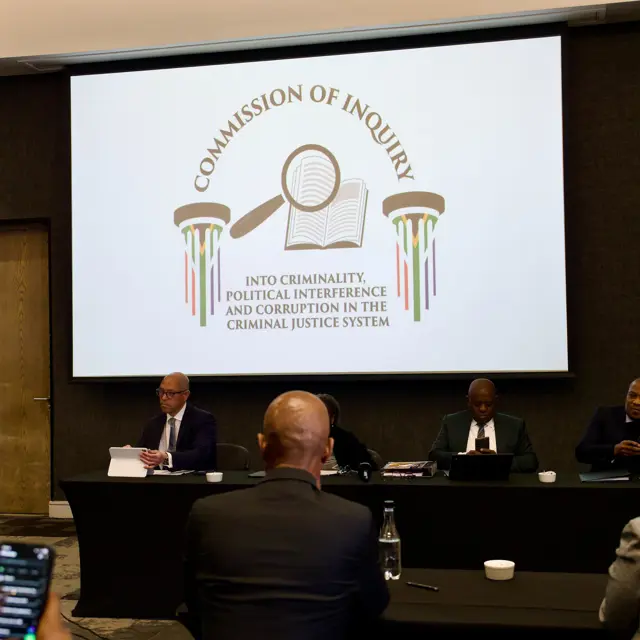
Justice Mbuyiseli Madlanga on Tuesday rejected an urgent attempt by a police officer known as Witness F to delay giving evidence at the Madlanga Commission, after his lawyer said the witness feared testifying would incriminate him.

Madlanga ordered the inquiry to proceed with WhatsApp messages attributed to Witness F, despite an urgent court bid challenging how the chats were obtained.

The morning began with disruption when advocate Hartley Ngoato, counsel for Witness F, arrived late, prompting sharp criticism from Madlanga.

Ngoato explained that he had just come from the Gauteng High Court after filing an urgent application aimed at halting his client’s testimony, but Madlanga rejected the explanation outright.

“I don’t understand why you had to be the one to be at the high court to file the application,” Madlanga told him, calling his lateness “unprofessional”.

Despite Ngoato’s insistence that he had been attempting to communicate with the commission’s lawyers since Monday and had “no intention to disrespect the commission”, Madlanga said he did not accept what he viewed as excuses.

It soon emerged that Witness F, a police officer whose WhatsApp messages form central evidence in the inquiry, had launched an urgent high court bid seeking to prevent the commission from using those communications.

According to Ngoato, his client “does not want to testify because he fears he will implicate himself”.

The application, he said, sought to prevent the commission from compelling Witness F’s appearance, while also challenging how the WhatsApp chats had been extracted from his phone.

He claimed the messages “leave a lot to be desired”, arguing some portrayed his client “to be the sender when in actual fact he’s not the sender”.

Ngoato repeatedly argued that the commission’s interim report had publicly identified several officers for referral to criminal investigation — a list made public by President Cyril Ramaphosa — and that his client’s inclusion in it heightened the risk of self-incrimination.

“He will dig a grave for himself,” he insisted.

Chief evidence leader and senior counsel Matthew Chaskalson strongly opposed the postponement attempt, branding it “confusing”, “hopeless”, and “an abuse of process”.

He pointed out that Witness F had been aware since November 2025 that he would be called to testify and had received the relevant WhatsApp messages 12 days ago.

“He has no basis for preventing the commission from having regard to those chats. If he wanted to bring some application in that regard, the time to launch that application was 12 days ago. He chose not to,” Chaskalson said.

Chaskalson argued the fair-trial complaint was a “non-starter” because the Commissions Act protects witnesses from self-incrimination: they may refuse to answer incriminating questions, and compelled evidence cannot be used against them in a criminal trial.

After hearing arguments, Madlanga refused the application for a postponement.

He ruled that the commission was legally entitled to continue, noting there was no court order preventing the display of the WhatsApp messages.

He then said the evidence leaders “can lead the WhatsApp evidence”.

Madlanga stressed that the commission could not allow the witness to evade accountability.

The commission continues.

INSIDE POLITICS

More articles

LEAVE A REPLY

Please enter your comment!
Please enter your name here

AVBOB STEP 12

Inside Education Quarterly Print Edition

Inside Metros G20 COJ Edition

JOZI MY JOZI

QCTO

Latest article