

By Thapelo Molefe
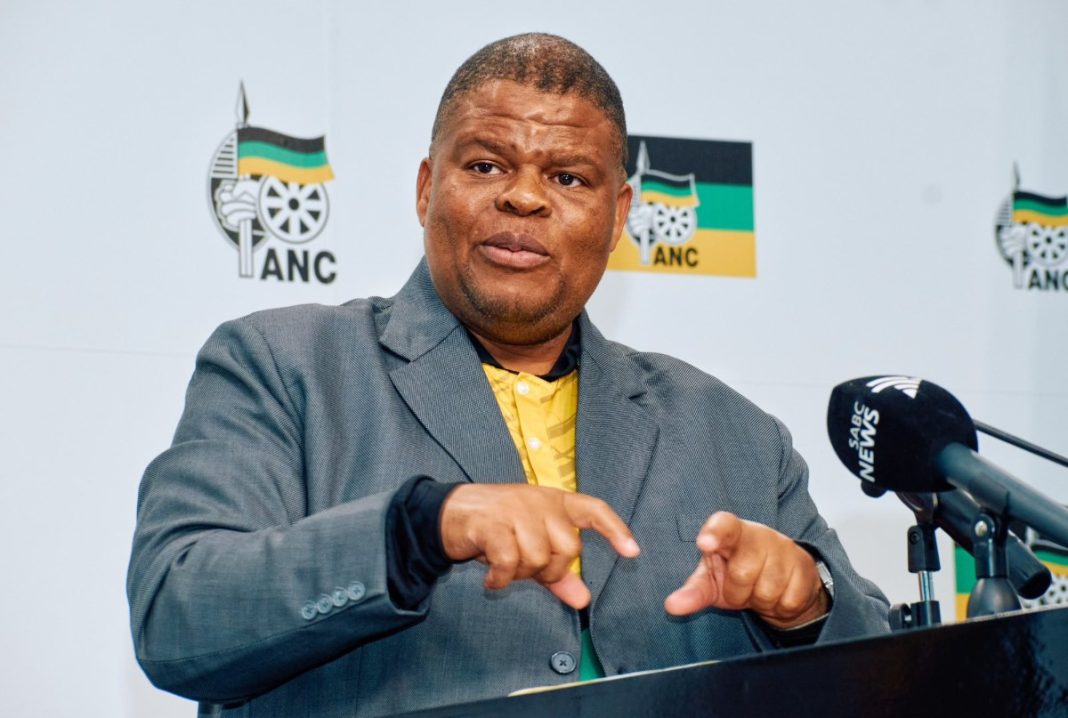
Deputy Minister of Water and Sanitation and ANC NEC member David Mahlobo said the ANC-led government had provided the “highest level of leadership” on water security and sanitation, as the party reviews its 2021 Local Government Elections Manifesto ahead of the 2026 polls.
Mahlobo was speaking on Sunday during the ANC’s manifesto review, which focused on housing, water and energy.
The briefing is part of the party’s assessment of progress made against its 2021 commitments, the challenges that remain and its priorities towards the 2026 Local Government Elections.
His remarks come as parts of metros, towns and cities across the country experience daily and weekly water outages and shortages — largely the result of poor infrastructure maintenance — and have done so for years.
READ: WaterCAN questions Johannesburg Water’s finances despite City’s ringfencing pledge
“The ANC government has actually provided the highest level of leadership when it comes to water security and water supply and sanitation supply in the country,” Mahlobo said.
“For the first time, we know that this matter (via the National Water Action Plan) is led by His Excellency Comrade President Cyril Ramaphosa. In the same vein, he elevated issues of energy security.”
Mahlobo said access to water had increased to 91.3% in 2026, while access to sanitation stood at 85.6%.
He said, however, that these figures had to be considered against the experience of communities that continue to face unreliable water supply.
“But when we give you these figures, there is a qualification. The qualification is around the issues of reliability. The number of days per week, per year in which water will be available in the tap,” Mahlobo said.
He said ageing and deteriorating infrastructure remained a problem and that some households and businesses continued to experience water insecurity.
“Therefore, the task of government is not only to expand access, but to ensure that water and sanitation services in the main are reliable, sustainable, and are capable to meet the demands of our growing population and the demand for our economy.”
Mahlobo said the water crisis had become one of the government’s “apex priorities” because of its effect on livelihoods and the economy.
He said Ramaphosa’s National Water Action Plan provided a roadmap for immediate, short, medium and long-term interventions, but the test would be whether government could execute it.
“The only issues we need to be tested on…is on issues of execution,” Mahlobo said.
He said that municipalities struggling to provide water and sanitation would not be left to deal with the problems on their own.
READ: ANC pledges to tackle water crisis as key election priority ahead of 2026 local government polls
He said the ANC’s Local Government Intervention committee would support municipalities where capacity was inadequate and intervene where municipalities continued to fail.
“Therefore, we say it requires a coordinated action across all spheres of government,” he said.
He said the government had set aside R156 billion over the next three years in grants and subsidies to support water and sanitation at local government level.
He said government was also targeting communities that had remained without water infrastructure since the dawn of democracy.
He said these included rural communities, informal settlements, communities on farms and people living on private land.
According to Mahlobo, government was using alternative water sources, including groundwater, spring protection and sand-water abstraction, to reach these communities.
‘Decentralised water solutions’
He pointed to Hammanskraal as an example, saying government had introduced decentralised water solutions using groundwater, boreholes, treatment and reticulation.
Mahlobo said 27 projects had been opened in Hammanskraal, with further interventions taking place in KwaZulu-Natal and the Eastern Cape.
“Where municipalities are failing, within the available statutory resources, we shall intervene,” Mahlobo said.
“We are not going to say it’s not our job, you do your job, but if you can’t do your job, we cannot actually expose citizens to mediocrity, non-deliver.”
Human Settlements Minister and ANC NEC member Thembi Simelane said the manifesto review had to provide an honest assessment of the party’s performance as the current local government term approaches its end.
Simelane said the 2021 manifesto had been adopted as South Africa was emerging from the Covid-19 pandemic, with municipalities facing financial pressures, infrastructure backlogs and declining public confidence in local government.
“An honest assessment, therefore, as we’re about to close the term of 2021 local government elections, ending in this November 2026, calls on us to give an honest assessment,” Simelane said.
She said almost five million housing units had been delivered since 1994, benefiting more than 20 million South Africans.
Simelane said the government had also delivered about 231,000 serviced sites, while more than 300,000 sites had been made available during the period under review.
She said that serviced sites were intended to help people who did not qualify for traditional RDP housing but still needed assistance to access land.
“We give you land where we have built internal roads for you, we have put lights for you, we have put electricity for you, and we have put water connectivity,” Simelane said.
She said government had also disbursed 5,916 subsidies for first-home financing, including in rural municipalities, while more than 24,000 mortgage-related interventions had been recorded during the period under review.
Simelane said the department was also focusing on bringing housing closer to economic opportunities and public transport.
She said there were 94 priority human settlement development areas and around 136 development priority areas intended to drive spatial transformation.
Government has received about 14,000 hectares from the Department of Public Works, with a further 2,698 hectares released through the Housing Development Agency, she said.
For the 2026/27 financial year, the Human Settlements Development Grant business plan provides for R13.2 billion, with targets including 12,265 serviced sites, 38,019 housing units, 11,195 solar installations and 18,337 title deeds.
Missed target
Simelane also acknowledged that the government had missed its target for upgrading community residential units, including hostels.
She said the target had been 18,000 units, but the programme fell short by about 4,900 units, with social facilitation among the challenges.
She said the ANC wanted to improve its rent-to-buy policy for social housing, particularly for people who had lived in rented units for many years and now regarded them as their homes.
Electricity and Energy Minister and ANC NEC member Kgosientsho Ramokgopa said the ANC had treated load shedding as an “existential crisis” and accepted that the electricity crisis had been avoidable.
Ramokgopa said the crisis reflected weaknesses in maintenance, delayed investment, governance failures, corruption and slow implementation of necessary decisions.
“The ANC had characterised load shedding as an existential crisis. It delivered a devastating blow to the economic growth prospects of the country, and we had to take extraordinary measures to resolve load shedding,” Ramokgopa said.
“And we have come to accept that load shedding was, in fact, avoidable.”
He said the Energy Action Plan introduced by Ramaphosa was aimed at fixing Eskom, accelerating private-sector investment and public procurement of new generation capacity, encouraging rooftop solar and introducing greater competition into the electricity sector.
Ramokgopa said the energy availability factor had improved dramatically.
“At the peak of load shedding, the energy availability factor was 48 percent,” he said.
“On the 26th of July, about two weeks ago, the energy availability factor was at over 80 percent, the first time since 2017. And this is sustained.”
But Ramokgopa said the government could not yet declare victory.
‘Monster of load reduction’
“However, we are of the opinion that we are at no place to declare victory because of the monster of load reduction,” he said.
He said the government needed to end load reduction because residents experiencing it could see little difference between load reduction and the load shedding they had previously endured.
“The experience of an average citizen who is subjected to load reduction is that is a change of names. They’re still subjected to the same levels of interruption,” Ramokgopa said.
He said load reduction was linked to overloaded networks, illegal connections, vandalism, transformer failures, inadequate distribution investment by Eskom and municipalities, and the exclusion of qualifying households from free basic electricity.
Ramokgopa said seven of the country’s nine provinces were now free of load reduction, leaving Gauteng and KwaZulu-Natal.
“We are accelerating our efforts to ensure that we are able to end load reduction in those areas,” he said.
Ramokgopa also said the ANC remained committed to a just energy transition, saying that the transition had to improve energy security, reduce emissions, improve air quality and create new industrial opportunities.
He said government was working on expanding the electricity grid by 4,000 kilometres and intended to use the energy transition to build skills, strengthen research and development and expand South Africa’s manufacturing and engineering capabilities.
The minister said the cost of electricity remained another major problem.
“We accept that the cost of electricity is an elephant in the room,” Ramokgopa said.
He said electricity tariffs had increased by more than 907% since 2007, while inflation had increased by about 150% over the same period.
“The electricity is available but not accessible,” he said, saying that households, including middle-class households, were struggling to afford electricity.
Ramokgopa said the government wanted to increase the free basic electricity allocation from the current 50 kilowatt hours and introduce greater transparency in electricity tariffs.
He also called for municipalities to make greater use of their ability to generate their own electricity using sources such as wind and solar.
INSIDE POLITICS