

INSIDE POLITICS NEWS DESK
Finance Minister Enoch Godongwane announcement on Wednesday in his much-anticipated 2024 budget speech that the government has been forced to tap from the Gold and Foreign Exchange Contingency Reserve Account (GFECRA) to help stave off the government’s spiralling debt crisis, has had mixed reactions from opposition parties.
Leaders from the UDM, FF Plus, the IFP and the ACD spoke to the SABC after Godongwana’s budget and pretty much agreed that the Minister had to deal with the spiraling debt crisis and had little room to wiggle but raid the Treasury.
Reports say this is not the first time South Africa has found itself in this position and that the government also tapped into the reserves in 2003 and the settlement was to the value of R28 billion.
Godongwana started his speech by outlining the global outlook that he said was optimistic. But despite the improved global outlook for 2024, South Africa’s near-term growth remains hamstrung by lower commodity prices and structural constraints.
“We estimate real GDP growth of 0.6 per cent in 2023. This is down from 0.8 per cent growth estimated during the 2023 MTBPS. The revision is due to weaker-than-expected outcomes in the third quarter of 2023, particularly in household consumption and fixed investment. Between 2024 and 2026, growth is projected to average 1.6%,” he said.
But, there are also risks to the domestic outlook, he pointed out and these include persistent constraints in electricity supply, freight rail and ports; and a high sovereign credit risk, he said.
“Our challenge, honourable members, is that the size of the pie is not growing fast enough to meet our developmental needs.
“As such, our fiscal strategy supports economic growth and reduces risks to the economy while ensuring fiscal sustainability.
“Compared to a year ago, the budget deficit for 2023/24 is estimated to worsen from 4% to 4.9% of GDP. The higher budget deficit means that debt-service costs in 2023/24 have been revised higher, by R15.7 billion to R356 billion Debt-service costs will absorb more than 20% of revenue. To put this into perspective, spending on debt-service costs is greater than the respective budgets of social protection, health, or peace and security.
“A net reduction of R80.6 billion in non-interest expenditure is being implemented over the medium-term. At the same time, revenue has been revised up by R45.6 billion over the medium-term, relative to 2023 MTBPS. And, we have taken the decision to introduce a reform of the Gold and Foreign Exchange Contingency Reserve Account, also known as GFECRA.
“Taken together, even with the spending increases I will announce later, the national government gross borrowing requirement will decline, from R457.7 billion in 2024/25 to R428.5 billion in 2026/27. The deficit will begin to improve from 2024/25, to an estimated 4.5 per cent of GDP, reaching 3.3 per cent by 2026/27.
“Debt will now peak at 75.3% of GDP in 2025/26.
“All of this puts us in a position to continue to protect core services. It allows 60% of non-interest spending to be directed to the social wage. It also allows us to preserve capital spending.
“Compared to the MTBPS, we are adding R57.6 billion to pay for the salaries of teachers, nurses and doctors, among many other critical services,” Godogwana said.
One EFF MP said his budget was a blow to the youth of South Africa especially because of the cuts inNSFAS funding. An EFF MP told the SABC that Godongwana cut funding to municipalities although they were in dire straits and needed more money to deal with service delivery expectations from the residents.
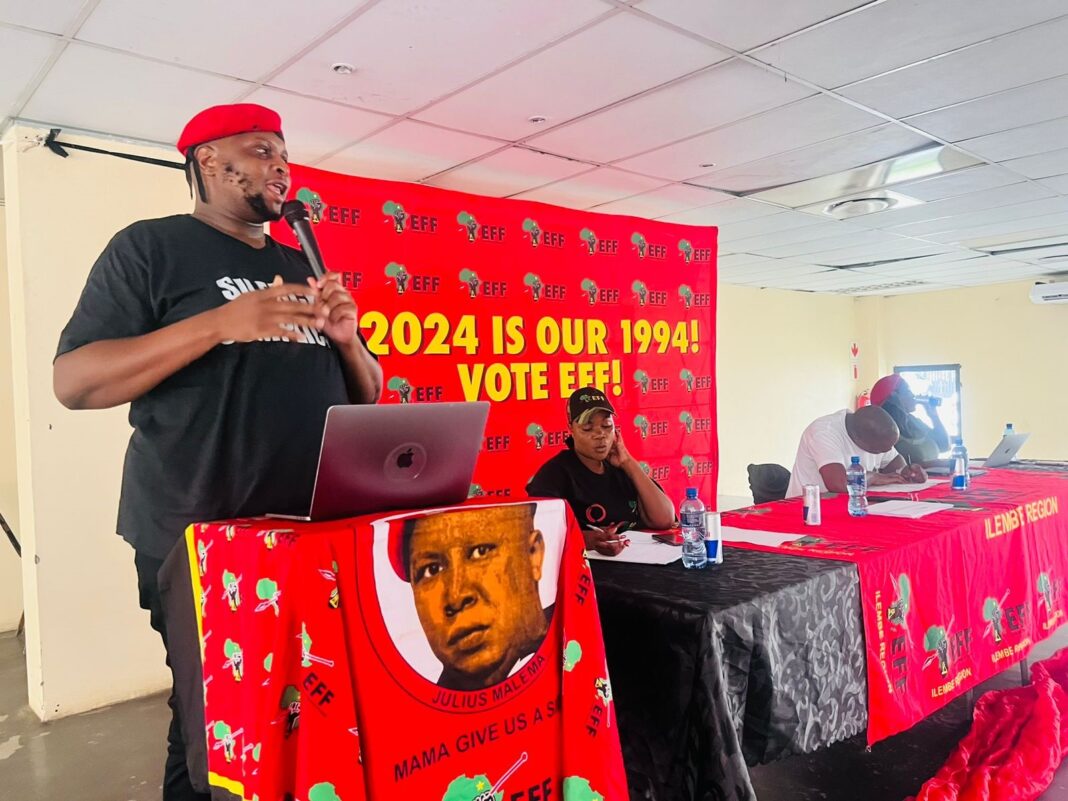
EFF leader Floyd Shivambu described the budget as “underwhelming” and very thin on detail particularly when it comes to economic growth and job creation.”There is nothing new that inspires hope that we will give meaningful jobs to the more than 11 million unemployed”.
While Willie Madisha, a veteran MP said this was the worst speech in 25 years and in it, Godongwana had no clear plan to grow the economy instead the government will continue to borrow, he said.
The FF Plus leader said he was relieved that there was no increase in fuel levy for cash-strapped motorists.
And Inkosi Mfakazeni Buthelezi from the IFP said the budget was much balanced and he appreciated the fact that the government was on track on revenue collections and the issue of government debt was being addressed.
More increases on social spending on grant payment to help cash-strapped consumers would have provided much financial relief, said an ACDP leader.
UDM’s Nqabayomzi Kwankwa had the last word when he described the budget as “not too bad and not too shabby” adding that the Minister spoke to debt stabilisation.
What are your views on the budget speech? Email your views to phutim@insidepolitic.co.za or share your comments on X @InsidePolitics8.