- Advertisement -spot_img

Ramaphosa unveils ambitious R1 trillion infrastructure investment plans at SIDSSA 2025

- Advertisement -spot_img

Must read

By Thapelo Molefe 

President Cyril Ramaphosa has unveiled an ambitious infrastructure investment strategy for South Africa.

He announced that the government will invest over R1 trillion in public infrastructure over the next three years.

He also called on the private sector to contribute an additional R3 trillion to help drive economic recovery and promote regional integration.  

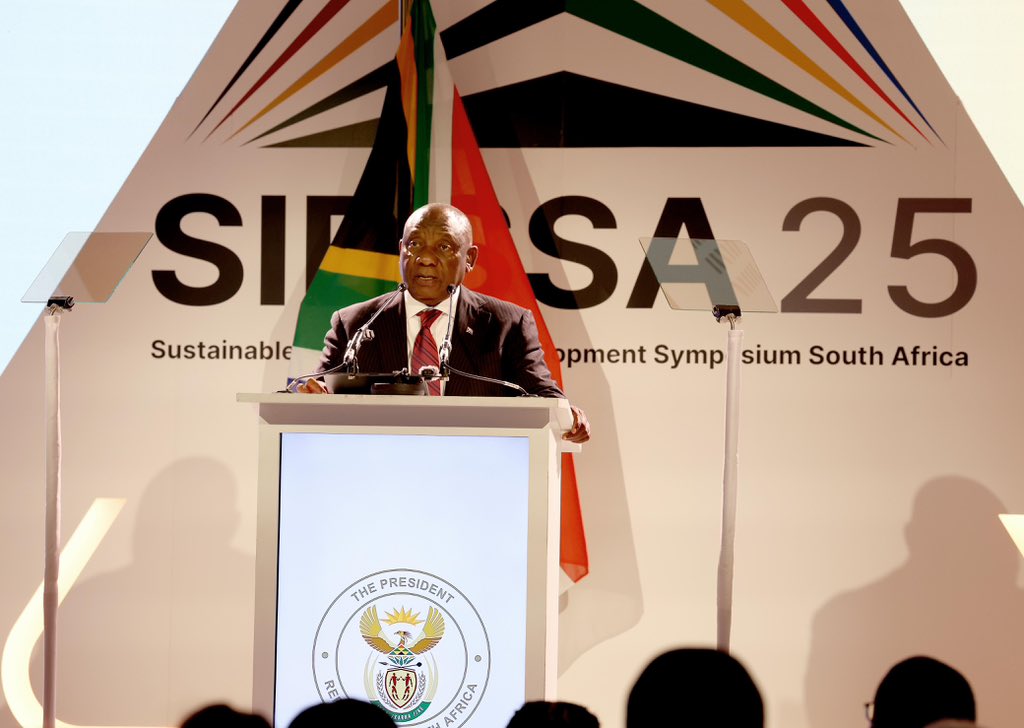
Speaking at the Sustainable Infrastructure Development Symposium South Africa (SIDSSA) 2025 in Cape Town on Tuesday, Ramaphosa described infrastructure as the foundation of South Africa’s development and the key to driving inclusive growth, job creation, and continental competitiveness.

“Infrastructure is the flywheel that our economy needs to boost growth and to create jobs,” Ramaphosa told an audience of government officials, industry leaders, investors, and international dignitaries. 

“If the government contributes R1 trillion, I want the private sector to bring in R3 trillion. That is where the money should come from. Armed with that, we then become a locomotive, unstoppable, because out of that R3 trillion that you will invest, you will get a good return. You will make money, and we will turn South Africa around and make it  a true construction site, but a beautiful site for all to behold.”

SIDSSA 2025 marks the first such symposium under the 7th Administration and the recently formed Government of National Unity.

The three-day event, held from Sunday to Tuesday, convened key stakeholders in the infrastructure, finance and policy sectors to accelerate delivery and investment readiness.

The president emphasised that the state cannot fund infrastructure alone, and that unlocking domestic and international capital would depend on project credibility, policy certainty and streamlined regulations. 

New reforms have been introduced to fast-track public-private partnerships (PPPs), particularly those under R2 billion, significantly reducing bureaucratic delays that have previously plagued infrastructure rollout.

“We are implementing the reforms necessary to make it easier for more construction by reducing regulatory duplication and providing investors with long-term certainty. Where regulation is duplicated, come forward and point it out. Don’t protest, talk to us,” Ramaphosa said.

A highlight of the symposium was the launch of the second edition of the Construction Book 2024/2025, which lists 250 fully funded, procurement-ready projects worth more than R238 billion.

These span transport, water, energy, digital infrastructure, human settlements and social services. 

The Construction Book aims to provide clarity and transparency to contractors, suppliers and financiers on upcoming demand and timelines.

“This edition is the most comprehensive record of infrastructure readiness South Africa has produced to date,” said Minister of Public Works and Infrastructure Dean Macpherson, who also delivered opening remarks. 

Macpherson reiterated the government’s goal of turning SA into a construction site, underlining infrastructure’s multiplier effect on job creation and economic expansion.

Since SIDSSA was established in 2020, more than 300 Strategic Integrated Projects (SIPs) have been gazetted.

Over two-thirds of these are now in procurement or construction, with over R300 billion committed since 2021.

The capital value of SIPs has risen from R340 billion in 2020 to over R1.3 trillion in 2025.

Ramaphosa highlighted key completed projects, including the Hazelmere Dam wall raising project in KwaZulu-Natal and the 100 MW Redstone Concentrated Solar Power Plant in the Northern Cape.

The latter now supplies clean energy to over 400,000 people daily.

In the past financial year alone, the Projects Preparation Fund supported the development of 34 infrastructure projects with an estimated capital value of R259 billion. 

Seven new nationally significant infrastructure projects were unveiled for the 2025/2026 cycle, underscoring the government’s commitment to targeted, high-impact development.

These included the Namakwa and Nkomazi Special Economic Zones, the Amatola Bulk Water Augmentation Project, and Phase 2 of the Rooiwal Wastewater Treatment Works. 

Also announced were Eskom’s Tubatse Pumped Storage Scheme and Transnet’s Liquefied Natural Gas Project at the Port of Ngqura.

Each of these projects has been identified for their catalytic economic potential, regional development impact and readiness for implementation.

Over R600 million was committed last year to prepare municipal and public entity projects for bankability.

Ramaphosa emphasised that such groundwork was essential to overcome previous shortcomings, where projects were launched without technical readiness, cost realism or proper stakeholder alignment.

“We had many sod-turning ceremonies but very few ribbon-cutting ceremonies. Infrastructure South Africa was established to break this pattern,” said Ramaphosa.

Last year, through SIDSSA, the Leaders Forum meeting was inaugurated.

The Leaders Forum is a vital platform for bringing together infrastructure ministers from across the African continent, creating space for strategic dialogue, knowledge exchange and policy alignment. 

“Now, this level of collaboration is in the end essential if we are going to overcome shared challenges and realise the full potential of the African continental free trade area by bringing together our collective expertise and political will to strengthen the foundations for inclusive and sustainable growth,” Ramaphosa said.

“South Africa cannot succeed alone, and Africa cannot industrialise without infrastructure at its core,” minister Macpherson said.

“SIDSSA is where we reinforce our commitment to regional collaboration.”

Ramaphosa echoed the sentiment, citing initiatives like the Lobito Corridor, which links Angola, Zambia and the DRC, as key examples of how regional partnerships can unlock shared prosperity.

Macpherson also revealed that two major agreements were signed during the symposium.

He noted that  French firm Meridiem SAS would fund project preparation for the Doctor Municipality Infrastructure Programme, while Huawei supports broadband infrastructure and digital transformation in schools and human settlements.

These partnerships signal growing global investor confidence in SA’s infrastructure trajectory.

The President described the country as being “primed” for take-off.

“We are now like an airplane on the tarmac, ready to take off,” he said.

“If there was ever a time for us to surge ahead with infrastructure, this is the time.”

INSIDE POLITICS

More articles

LEAVE A REPLY

Please enter your comment!
Please enter your name here

AVBOB STEP 12

spot_img

Inside Education E-Edition

spot_img

Inside Metros G20 COJ Edition

spot_img

JOZI MY JOZI

spot_img

QCTO

spot_img

Latest article