



By Johnathan Paoli
President Cyril Ramaphosa has urged Indian businesses to deepen their investment in South Africa, saying the country’s economic reforms are creating opportunities in infrastructure, energy, mining, agriculture and the digital economy.
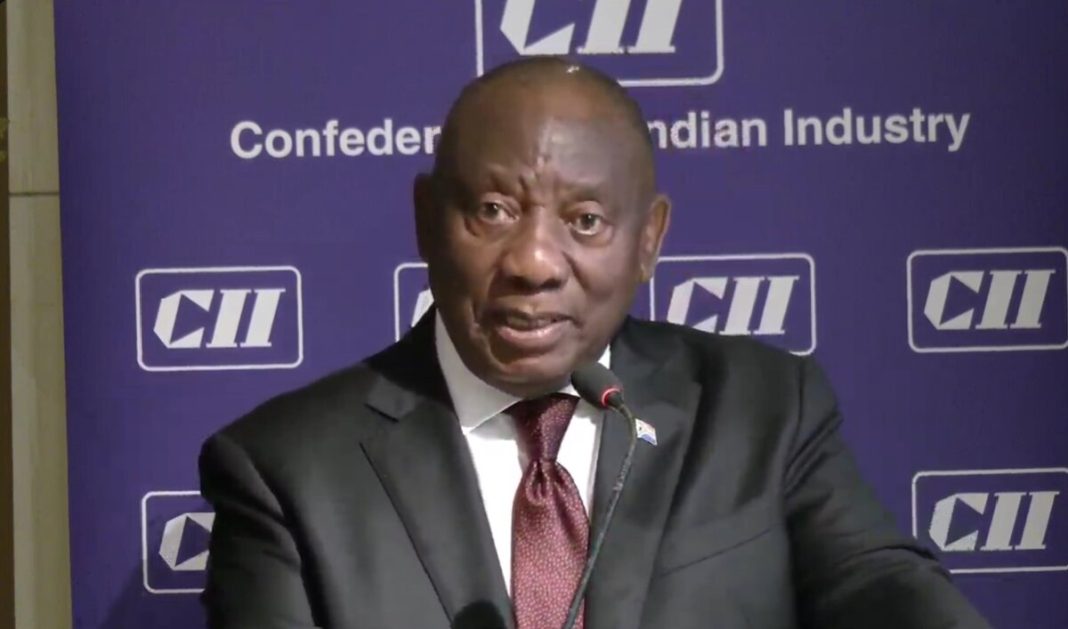
Speaking at the India-South Africa Business Leadership Roundtable in New Delhi on Saturday, Ramaphosa pitched South Africa as an investment destination undergoing major reforms and encouraged Indian companies to use the country as a gateway to the rest of Africa.
“India is powering ahead and South Africa is open for business. South Africa is transforming its economy, undertaking far-reaching changes in our energy, telecommunications, logistics and water sectors. We have emerged from more than a decade of electricity shortages into a new era of investment and competition. We are reviving our freight rail system and our ports, enabling the participation of new operators and investing in expanding capacity. These reforms are focused on reducing the cost of doing business and making our economy more competitive,” he said.
Ramaphosa said more than 150 Indian companies had invested over $10 billion, or more than R161 billion, in South Africa and created more than 18,000 jobs.
He said the next phase of the relationship should be built around investment, trade, exports, innovation and industrial development, rather than diplomatic engagement alone.
Ramaphosa acknowledged that the government had not done enough to strengthen ties with India, but said the weakness had been offset by growing business links.
“In a way, in our internal briefing yesterday, we did comment that we have in a number of ways as the government neglected our relationship as South Africa with India. But that weakness has actually been ameliorated by the relationships that businesses have had with South Africa from India. A number of businesses from India have invested in South Africa and that we are eternally grateful for,” he said.
Ramaphosa said reforms in the energy, telecommunications, logistics and water sectors were intended to lower the cost of doing business.
He pointed to efforts to revive freight rail and ports and said the government had embarked on the country’s largest infrastructure investment programme, with the state committing up to R1 trillion.
South Africa has also identified 195 strategic integrated projects worth more than $100 billion, or about R1.61 trillion, across priority industries. Ramaphosa called on Indian companies to help deliver them.
“To support this infrastructure drive, we are investing in project preparation to ensure that all these plans translate into roads, rail corridors, renewable energy plants, transmission lines, water treatment plants and hospitals. We have produced our third Construction Book, which provides a national overview of funded projects that are expected to be issued for tender in the next 18 months. We encourage Indian companies to consider partnerships to participate in these,” he said.
Ramaphosa identified the energy transition, green hydrogen, critical minerals and battery manufacturing as further areas for cooperation.
He said Indian companies could establish manufacturing and investment operations in South Africa and use the country as a base from which to reach African and global markets.
“We believe that other large companies can anchor their investments in South Africa and use it as a base to export into Africa and the rest of the world. And a number of your companies in talking to us said that they see South Africa as a gateway into the African continent because of the advantages that South Africa has,” he said.
Agriculture was another priority, with Ramaphosa saying South Africa could learn from India’s experience in supporting small-scale farmers.
He linked the challenge to South Africa’s history of land dispossession and said the government was seeking to revive the participation of black South Africans in agriculture.
Ramaphosa also pointed to Indian-headquartered Atain’s expansion in Cape Town, which is expected to increase its local workforce from 1,500 to more than 2,000 young South Africans.
He joked that recovering from a cold had restored his sense of smell and that the room carried a particularly promising scent.
“As I entered this room, because my sense of smell has improved greatly, I could smell money. So meeting with you here, I have a greater sense that I’m in the presence of people with money. So I want you to come and invest in South Africa,” he said.
Ramaphosa said the success of the relationship should ultimately be judged by what the two countries achieved, rather than the agreements they signed.
INSIDE POLITICS






