

By Johnathan Paoli
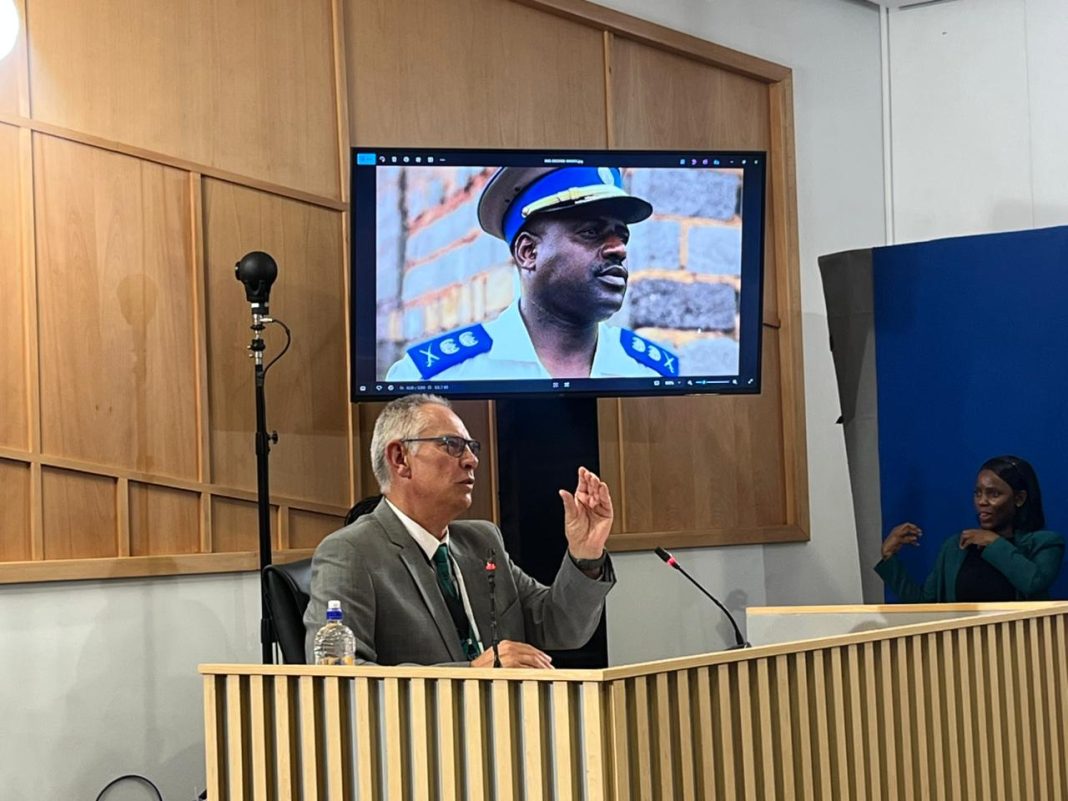
Deputy chief of police for Asset Protection and Security Services, Commissioner Revo Spies, has revealed how the Tshwane Metropolitan Police Department (TMPD) facilitated tender processes with companies that were riddled with irregularities, governance failures and possible manipulation.
Appearing before the Madlanga Commission of Inquiry on Tuesday, Spies outlined two tender processes involving 22 companies, which were extended beyond their 3-year term, due to a court ruling.
“It was not awarded to the 22 through the City’s actions, even though they were evaluated and the report continuously then stated it should be cancelled. The 22 companies took the decision to court and that’s when the court then made the ruling must be awarded,” Spies said.
The first tender issued in the 2016/2017 financial year, was meant to appoint service providers to supply physical security guarding for municipal assets and personnel.
Spies told the commission that the first bid evaluation process collapsed after officials removed bid documents from official premises to an external location, leading to missing documentation.
“They removed all the bid documents to an unknown venue, and later returned the documents, and then there were missing documents. When they returned it, six documents were missing,” he said.
This prompted a recommendation that the tender be cancelled and restarted, but a legal challenge by a bidder resulted in a North Gauteng High Court ruling by Justice Hans Fabricius that the tender could not be cancelled, forcing the city to re-evaluate bids.
A second evaluation process also flagged irregularities, again linked to missing documents, and similarly recommended cancellation.
However, in a later court order, Justice Malopo Setosa directed that the tender be awarded to 22 companies that had been identified as successful during evaluation, despite no formal award having been made by the City’s bid adjudication structures.
Madlanga described this outcome as “odd”, noting that no official decision had been taken internally to award the tender to those companies.
Due to ongoing litigation between 2017 and 2022, the city relied on interim arrangements, extending previous contracts on a month-to-month basis for nearly five years.
The disputed tender was eventually implemented on 1 March 2022, with the 22 service providers appointed under court order for a three-year period ending in February 2025.
Spies testified that a new replacement tender process began in 2024, but was not finalised in time before the February 2025 expiry.
As a result, the city extended the existing contract for four months to June 2025.
This extension was approved through the Bid Adjudication Committee (BAC) and signed off by the City Manager Johann Mettler in his role as accounting officer.
The replacement tender (TMPD 03-2024/25) was ultimately cancelled in October 2025 after a lengthy review process uncovered further “material irregularities”.
These included ambiguities in pricing schedules, with inconsistent interpretations between evaluators and oversight teams; contradictory requirements relating to firearm licences; and missing bid documents, similar to the failures in the 2016 process.
Following the cancellation, a fresh tender process (TMPD 07-2025/26) was initiated in early 2026 and is currently under evaluation.
In the meantime, the original 2016/2017 tender, already extended multiple times, remains in operation and is expected to run until at least June 2026.
Commission Chair Mbuyiseli Madlanga warned that even formally approved processes could be “simulated”, suggesting that decision-makers like the City Manager might unknowingly sign off on manipulated outcomes.
Spies revealed that between March 2022 and January 2026, approximately R2.9 billion had been paid to the 22 companies under the tender, excluding additional ad hoc spending.
Commissioner Sandile Khumalo estimated that extensions alone could push total expenditure close to R1 billion beyond the original contract period.
Particular concern was raised over one company, Gubis85 Solutions, which received that around R3.5 million was paid per month for standard “watchman” services, with an additional R59 million in ad hoc payments between mid-2024 and mid-2025.
Spies also testified that purchase orders worth over R13 million for ad hoc services were created within days in March 2025, following alleged communications between Tshwane CFO Gareth Mnisi and a TMPD Deputy Police Chief Umashi Dhlamini.
Evidence leader Teboho Mosikili linked these payments to WhatsApp communications presented earlier during SAPS Gauteng Organised Crime Sergeant Fannie Nkosi testimony, suggesting coordination around procurement processes and payment approvals.
While Spies could not confirm the substance of those communications, he acknowledged that both officials played roles in the tender extension process.
The commission also probed whether procurement systems could be abused by generating purchase orders for work not actually performed.
Spies said controls exist, including site inspections and verification processes, but conceded that corruption could circumvent safeguards.
The commission adjourned for the day, with proceedings breaking for the Easter holiday and set to resume on 7 April.
INSIDE POLITICS