



By Johnathan Paoli
South African voters appear increasingly comfortable with the idea of coalition government, but are far less settled on which parties should govern together, a combination that could make post-election negotiations just as important as the 4 November vote itself.
A new News24 and SABI Strategy Group poll shows that 61% of registered voters would be happy to see a coalition govern their municipality after the local government elections, while only 32% would oppose such an arrangement.
The findings point to an environment in which voters may be prepared to accept fragmented councils, even as no particular coalition formula commands broad support.
The ANC-DA combination is the most popular of the proposed arrangements, but only 20% of voters selected it.
A coalition involving all 10 parties in the Government of National Unity followed at 19%, while ANC-EFF and ANC-EFF-MK combinations each received 15%.
A further 20% of respondents did not know which coalition they would prefer.
That lack of a clear preference could leave the political parties with considerable room to manoeuvre once the votes have been counted.
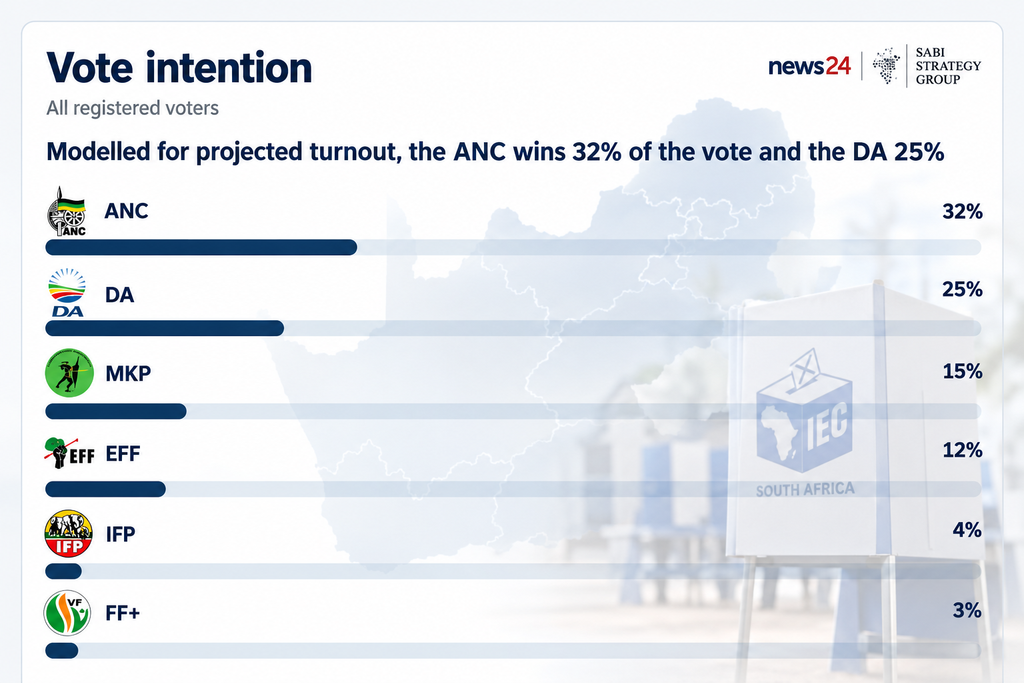
The poll places the ANC on 31.6% nationally, ahead of the DA on 25.2%, the MKP on 14.7% and the EFF on 12.2%.
But the national numbers conceal an even more complicated picture in the major metros.
In Tshwane, the DA leads with 32%, followed by the ANC with 24%, with the EFF on 14% and ActionSA on 11%.
The figures suggest that even if the DA emerges as the largest party, it could still require partners to form an administration.
Johannesburg presents a similar problem, with the DA unable to reach the level required to govern alone.
The result could once again make coalition negotiations the decisive factor in determining who controls the country’s economic hub.
But, the numbers are complicated by the parties’ relationships.
The DA and ANC are the most obvious potential partners where neither can secure a majority, while the DA’s opposition to working with the EFF and MK Party narrows its options.
The ANC, by contrast, has a wider potential pool of coalition partners and could potentially negotiate with the DA or seek an alternative arrangement involving the EFF, ActionSA and smaller parties.
In eThekwini, meanwhile, the MKP is the strongest force in the poll but could potentially be excluded from government if rival parties collectively secure enough seats.
This potentially makes smaller parties the ‘kingmakers’ with an unusual degree of potential influence.
The poll suggests voters understand and, to a significant extent, accept this new political reality.
Seven in 10 respondents (71%) believe November’s elections can bring about change in their municipality, compared with 19% who believe they cannot.
But that optimism exists alongside widespread dissatisfaction with the direction of the country and municipalities.
Some 69% of respondents believe South Africa is moving in the wrong direction, while 66% say the same about their municipality.
Jobs and unemployment are the biggest national concern, cited by 33%, followed by corruption at 16%.
The poll also reveals a striking gap between voters’ views of individual political leaders and their assessment of the GNU.
President Cyril Ramaphosa has a net approval rating of minus 17, with 40% approving of his performance and 57% disapproving.
The GNU performs considerably better.
Its net approval rating is plus 19, with 54% approving of its performance and 35% disapproving.
A separate question found that 59% believe the GNU has been good for South Africa, compared with 30% who believe it has been bad.
The contrast could be significant for the local elections, suggesting voters may be more receptive to the concept of parties sharing power than to individual parties or politicians.
Yet there is no guarantee that this translates into stable municipal coalitions.
South Africa’s municipalities have increasingly become sites of political bargaining, with parties required to negotiate over executive positions, budgets and governing arrangements when no organisation wins an outright majority.
The outcome can give smaller parties considerable leverage, but it can also produce unstable administrations when coalition partners fall out.
For the ANC, the poll represents another test of its ability to retain political relevance as its traditional dominance continues to erode.
For the DA, it demonstrates continued strength but also the limits of its ability to govern without partners.
For MKP and the EFF, the results show the potential to become decisive players even where they do not emerge as outright winners.
And for smaller parties, the election could provide an opportunity to punch well above their electoral weight.
The News24/SABI poll surveyed 5,001 registered voters between 25 August and 17 September 2026, including separate samples of about 1,000 voters in Johannesburg, Cape Town, eThekwini and Tshwane.
The national margin of error is 3.2 percentage points at a 95% confidence level.
INSIDE POLITICS






