

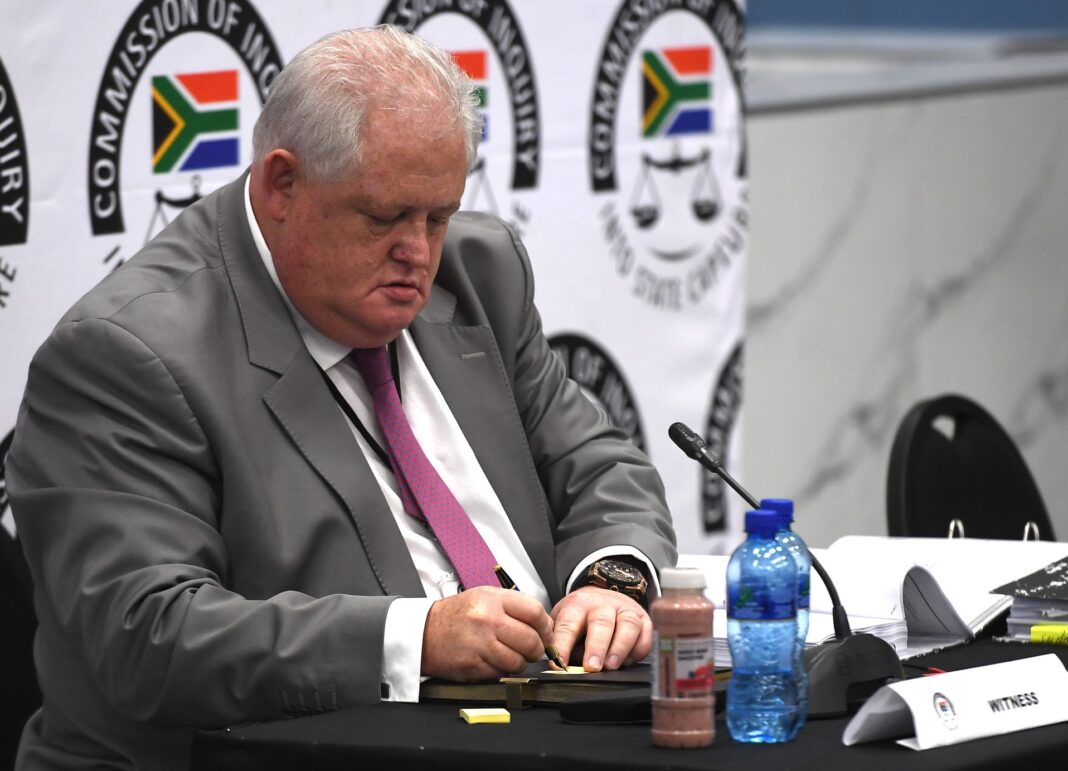


By Johnathan Paoli
Former Bosasa chief operating officer Angelo Agrizzi will appeal a High Court order directing him to pay the state R1.66-billion linked to the company’s corruption.
In a statement on Monday, Agrizzi said the confiscation order went far beyond his personal financial benefits and raised questions about how the proceeds of crime should be calculated.
“I support the recovery of the proceeds of crime. I ask only that a confiscation order reflect what I actually received, as the law requires. I do not dispute my conviction. I pleaded guilty, and I gave evidence before the Zondo Commission. The appeal concerns one question: how much money I actually received,” he said.
The Gauteng High Court in Pretoria ordered Agrizzi to pay R1,666,582,825.73, together with interest from the date of judgment until final payment.
He was also ordered to pay the legal costs of the confiscation proceedings.
Agrizzi said he respected the court but intended to challenge the ruling, arguing that the amount was based on Bosasa’s contracts rather than proceeds he personally retained.
“The R1,666,582,825.73 is not money I received. The State’s own heads of argument describe it as the value of the contracts the Department of Correctional Services awarded to Bosasa. I was Bosasa’s Chief Operating Officer, an employee. I was never a director or a shareholder of Bosasa. The contract payments were made to the company, not to me,” he said.
He argued that the Prevention of Organised Crime Act limited confiscation orders to the value of a defendant’s own proceeds, making the attribution of the company’s proceeds to him a central issue for the appeal.
Agrizzi also disputed the court’s findings concerning his financial disclosures and property in Italy.
He said that the state knew about the Italian property because it had been used as security for his bail, and that he would address the allegations of concealed assets during the appeal.
In his statement, Agrizzi portrayed himself as a whistle-blower who had cooperated with investigators but was being held responsible while other people implicated in the scandal remained uncharged.
“Almost eight years after I first gave evidence before the Commission, the most senior politically connected people it identified have not been charged. The politically connected escape accountability, while the person who came forward takes the full brunt. The whistleblower has become the scapegoat,” he said.
Agrizzi said he had provided detailed evidence to the Investigating Directorate Against Corruption and had continued corresponding with prosecutors and justice officials about investigations arising from the Zondo Commission’s findings.
He alleged that evidence he had prepared and handed over had been damaged, and complained of limited follow-up action against other people implicated in the scandal.
Agrizzi’s confiscation order follows his guilty plea in November 2025 to three counts of corruption and one count of money laundering.
His plea agreement resulted in a 40-year prison sentence, wholly suspended for five years on conditions including continued cooperation with the state.
His admissions detailed how Bosasa allegedly paid R75.7-million in bribes between 2000 and 2016 to secure government contracts worth approximately R2.37-billion.
The confiscation proceedings were separate from his criminal sentencing and focused on the financial benefits attributed to his unlawful activities.
Judge Mokhine Mosopa rejected Agrizzi’s argument that he could not be held responsible for the enterprise’s proceeds because others had also participated in the corruption.
Agrizzi said he would not comment further on the evidence while the matter remained before the courts.
INSIDE POLITICS






