

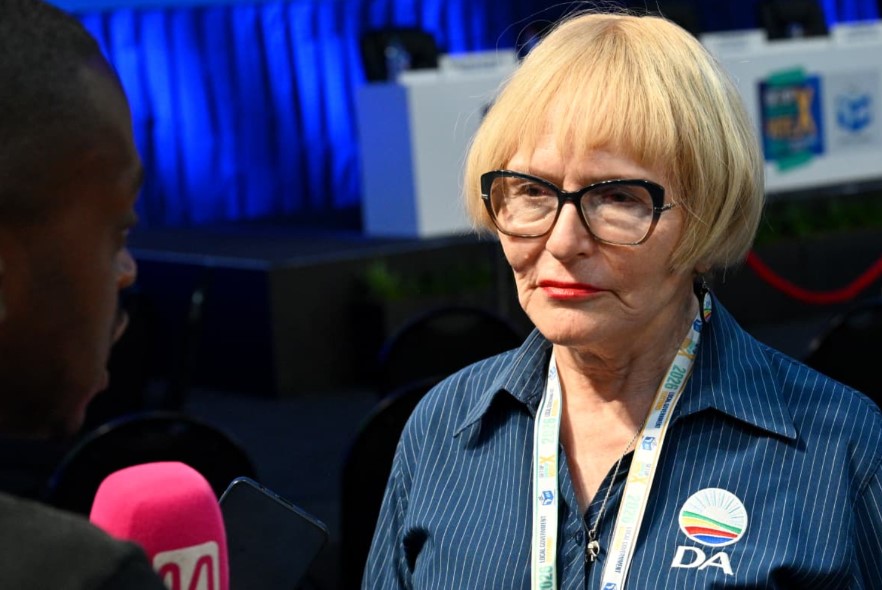


By Johnathan Paoli
DA Johannesburg mayoral candidate Helen Zille said she would only consider entering into a coalition government in the city if it could guarantee stability and sufficient political support.
“The negotiations are done nationally. So I can’t sit here and make conditions for my position. But I do have strong views, obviously. But, you know, the point is that we want a stable coalition and we want a governable coalition. And I’m not sure that I’d be prepared to go into government just for the sake of being in power. If we get into government, we have to be able to govern properly,” she said during an interview with Inside Politics at the IEC results operation center (ROC) in Johannesburg on Thursday.
Zille said the DA had made significant progress in Joburg during Wednesday’s local government elections, but that it remained to be seen whether its performance would be sufficient to secure the mayoral position.
She said she was closely monitoring the results as they came in, with the possibility of coalition negotiations likely to determine the political future of the country’s economic hub.
Asked whether she believed she would need the support of other parties to obtain the majority required to govern Johannesburg, Zille reiterated that discussions were being conducted nationally and that she would not independently set conditions for potential coalition partners.
READ: AT THE POLLS| Zille will tackle Joburg water crisis if elected mayor, but warns there’s no quick fix
But her comments suggested that the DA would be cautious about entering another coalition arrangement without sufficient guarantees that it could deliver stable administration.
It has previously governed Johannesburg through coalition arrangements, with political instability and shifting alliances contributing to changes in the city’s leadership over successive administrations.
Zille also acknowledged the enormous infrastructure and service delivery challenges facing Johannesburg, particularly the estimated R220-billion infrastructure maintenance and refurbishment backlog.
Asked how she would approach the problem, given that it was unlikely to be resolved during a single five-year municipal term, she agreed that the scale of the challenge required a longer-term intervention.
“It’s definitely not a five-year term resolution matter. I mean, that’s a backlog built up over 30 years. So what you have to do is triage the system. You have to say what is at the biggest implications for the most people. And on that basis, fix those parts first,” she said.
Her proposed approach would involve identifying the infrastructure failures affecting the greatest number of residents and prioritising those areas for intervention, rather than attempting to address the entire backlog simultaneously.
Johannesburg has faced persistent infrastructure challenges, including deteriorating roads, water and electricity infrastructure, ageing municipal assets and growing pressure on service delivery.
READ: The disruptors: Zille and Zuma shake up the battle for metros
Zille also indicated that she was encouraged by the DA’s performance in other major metros, specifically highlighting Cape Town and Ekurhuleni.
Asked whether she had been following the party’s results elsewhere, she said: “Yes. And of course, I’m very happy about Cape Town. And, you know, I’m looking at Ekurhuleni. It looks very nice, too.”
At the time of publication, with about 39% of the results counted, the DA was polling at 27.29% of the valid votes nationally, with 2,492,031 votes recorded.
It had secured 394 council seats and was leading in nine councils, with further results still to be processed.
INSIDE POLITICS






