
By Charmaine Ndlela
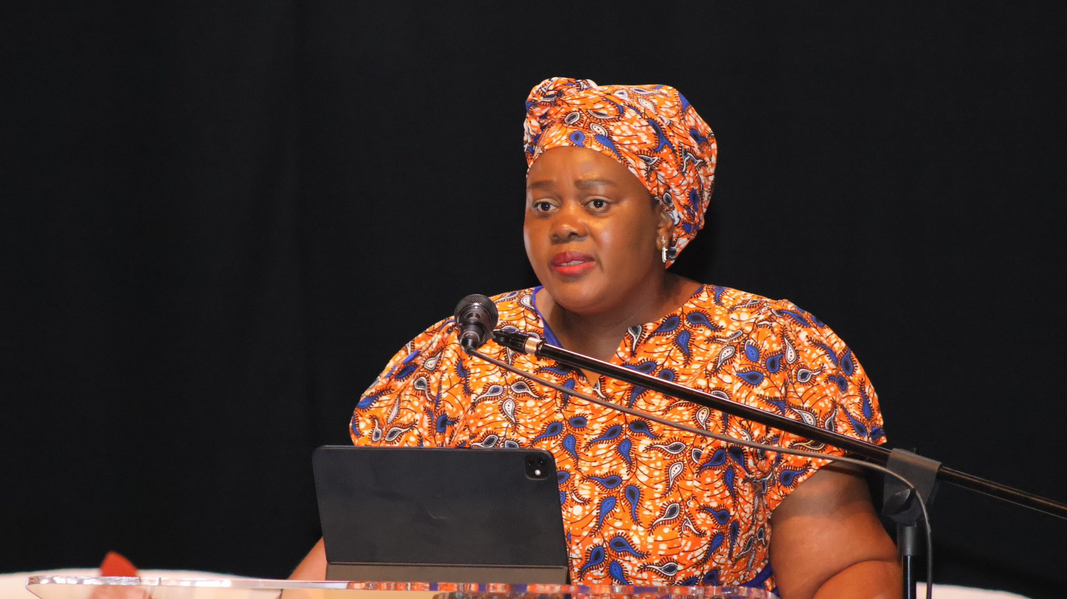
Justice and Constitutional Development Minister Mmamoloko Kubayi has warned that organised crime is infiltrating South Africa’s law enforcement agencies, with criminal syndicates allegedly working with officials to weaken institutions meant to fight crime and corruption.
Kubayi said the growing links between organised crime, corruption and law enforcement represented one of the most serious threats to the integrity of the criminal justice system.
“What the Madlanga Commission has exposed is the growing trend of organised crime and syndicate activities working together and interlinked within our institutions,” Kubayi said.
She was speaking at the University of Johannesburg’s third annual Combating Corruption Summit at the UJ Kingsway Campus in Auckland Park on Wednesday, under the theme: “Justice as the Cornerstone of Integrity: Turning Accountability into Action.”
“Perhaps the most worrisome aspect of the revelation at the commission is how much law enforcement agencies have been captured by organised crime organisations,” she said.
Kubayi said the emerging pattern included transnational drug trafficking, corruption and tender fraud within government structures, which in some cases was linked to contract killings and violent syndicates targeting whistleblowers.
She said some law enforcement officials were allegedly working with criminals to “repurpose and weaken” the very institutions responsible for fighting crime.
The minister said the revelations raised a critical question for government: how to protect law enforcement agencies from organised crime while preserving the integrity of the justice system.
She warned that tackling the problem required government to look beyond individual cases of corruption and confront the vulnerabilities that allow criminal networks to penetrate state institutions.
“We’ve got to get to the root cause,” Kubayi said.
She cited the case of a law enforcement official who was allegedly recruited into organised crime after experiencing financial difficulties following the death of his grandmother.
According to Kubayi, the official struggled to secure a bank loan to pay burial costs before a colleague connected him with people who offered financial assistance.
The assistance later came with a demand that he switch off a system monitoring the movement of cash-in-transit vehicles.
The official eventually became implicated in the criminal operation.
Kubayi said the case demonstrated how personal vulnerabilities could be exploited by criminal networks to compromise officials.
“These are simple things that we don’t understand. If we don’t analyse properly, we’ll solve the wrong problems,” she said.
She warned against relying solely on commissions of inquiry to address corruption.
“We’ll have this commission coming, we’ll implement the recommendation, down 10 years the line, we are back to square one,” Kubayi said.
Kubayi also highlighted progress in recovering assets linked to corruption.
She said the National Prosecuting Authority’s Asset Forfeiture Unit had recovered R8.3 billion, up from about R6 billion reported the previous year.
Of this, R3.6 billion was paid to victims, while R4.6 billion went to the Criminal Assets Recovery Account, which supports the fight against crime and assists victims.
Over the past year, the Asset Forfeiture Unit also secured freezing orders worth about R858 million and recovered assets valued at approximately R532 million, she said.
The Special Investigating Unit recovered assets and cash worth R936 million in the previous financial year, against a target of R1 billion.
Kubayi said the SIU’s role was increasingly focused on stopping irregular contracts while they were still underway, rather than recovering money only after losses had occurred.
She also warned about so-called professional enablers, including lawyers, accountants, auditors, bankers, estate agents and consultants, whose expertise can be used to facilitate or conceal corruption.
She said professionals could be involved in moving or concealing funds, establishing shell companies or certifying misleading documents.
“The continued use of professionals for concealment of corruption and avoidance of accountability should serve as a reminder that retribution for wrongdoing goes beyond the criminal justice system,” she said.
Kubayi challenged professional regulatory bodies to strengthen accountability mechanisms and disclose action taken against members implicated in corruption.
“How many of them have been able to hold those who have been listed accountable?” she asked.
She said the Zondo Commission had highlighted the role of professional enablers in facilitating the siphoning of billions of rand from state-owned enterprises.
With whistleblowers increasingly exposed to retaliation, Kubayi said government was finalising the Public Disclosure Bill to strengthen protections for people who expose wrongdoing.
The proposed legislation would provide secure reporting channels, protection against retaliation, confidentiality safeguards, protection against occupational detriment and access to witness protection where necessary.
It would also provide legal assistance to whistleblowers who cannot afford representation.
Kubayi revealed that government was considering establishing a dedicated whistleblower support fund.
She said whistleblowers could face severe financial consequences after exposing corruption, including having pensions and benefits withheld, losing their homes and seeing their children affected.
“The bill does not talk to any mechanism of financial support,” Kubayi said.
She said she was considering whether such a fund could be established, but argued that its administration should ideally sit outside government, with contributions from both the public and private sectors.
Kubayi also outlined plans to establish a permanent, independent overarching anti-corruption body.
She said one of the key recommendations of the National Anti-Corruption Advisory Council was to establish an institution responsible for preventing, investigating and remedying systemic corruption involving government and other organs of state.
The proposed body would also conduct anti-corruption audits and investigations, provide guidance and support to whistleblowers, and lead public education initiatives.
Kubayi acknowledged that its design would have to avoid duplication of existing mandates and protect the institution from political or criminal interference.
She said the debate over the country’s anti-corruption architecture had become particularly important in light of revelations emerging from the Madlanga Commission.
“I’ve been tasked to introduce” the anti-corruption agency, Kubayi said.
She said government needed to carefully consider what type of institution would be most effective in fighting corruption.
Kubayi said her department was also working with international institutions to strengthen the country’s response to corruption and organised crime.
She said she had approached the World Bank and the United Nations Office on Drugs and Crime to provide expertise for a panel that would assess weaknesses within the justice system and examine international best practices.
The work would include identifying weaknesses in the justice portfolio and developing reforms in response to challenges exposed by recent developments.
Kubayi said government was committed to acting on findings emerging from commissions rather than waiting for final reports, pointing to disciplinary processes, dismissals and court cases already under way as examples of “turning accountability into action”.
Despite the scale of the challenge, she remained optimistic about South Africa’s ability to defeat corruption.
“I’m optimistic that in the end, our fight against corruption shall be victorious,” she said.
The three-day summit brings together legal professionals, policymakers, academics, industry representatives, civil society and other stakeholders to examine justice, accountability, technology and integrity in South Africa.
University of Johannesburg Vice-Chancellor Professor Letlhokwa Mpedi warned in his welcoming address that South Africa’s corruption crisis could not be addressed by focusing only on technical failures within institutions.
Mpedi said failures in governance, procurement and accountability were often symptoms of a deeper problem involving how leaders and individuals understood their responsibilities to the institutions and communities they served.
“If our diagnosis stops at the technical level, our remedies will always be one step behind the next scheme,” Mpedi said.
He said South Africa urgently needed to rebuild confidence among people who speak out against wrongdoing and create an environment where accountability was understood as a collective responsibility.
“Every act of integrity, however unremarkable, is an act against corruption,” Mpedi said.
He said the annual summit was intended not only as a platform to discuss corruption, but to bring together government, business, the judiciary, law enforcement, civil society and young people to confront the structural conditions that allow corruption to thrive.
INSIDE POLITICS





