



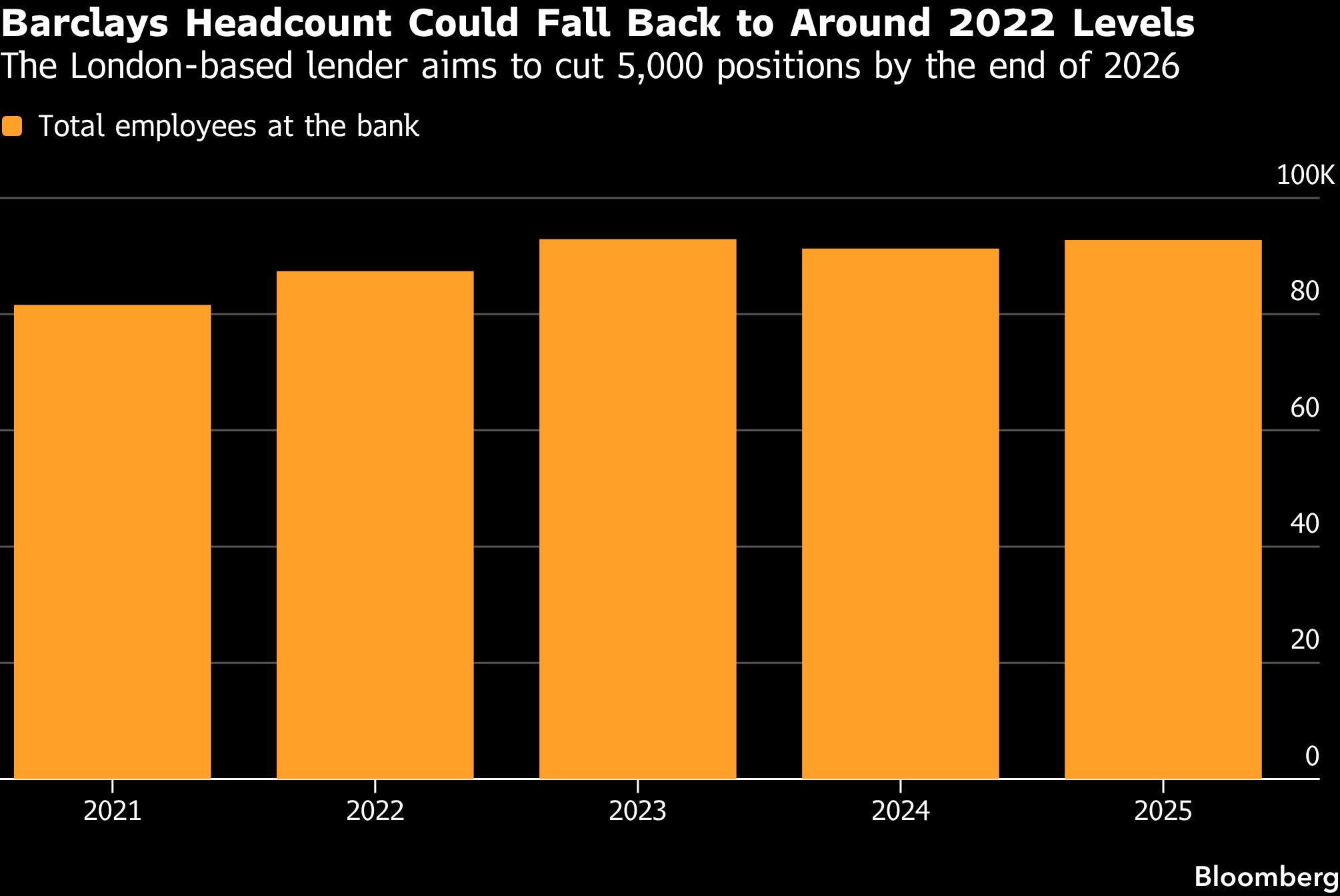
Barclays Plc said it’s cutting 5 000 jobs, or about 5% of total headcount, as part of a “technology-enabled” effort to reduce costs as it adopts artificial intelligence across the bank.
The bank reported third-quarter earnings Thursday that missed several key estimates. Barclays’ bond traders suffered the biggest slump on Wall Street during the quarter, taking the shine off a strong performance on the equities desk.
Revenue from fixed income and currency trading fell 19% compared with a year earlier to £1.01 billion ($1.4 billion), behind analyst expectations compiled by Bloomberg.
That meant the equities traders, who posted a 47% jump in revenue, almost matched that revenue haul with their best performance since at least 2009, the year after Barclays acquired the North American business of Lehman Brothers.
The bank said the fixed-income result reflected lower client activity in rates and credit, and “further adversity in September due to the macroeconomic environment.” On a call with reporters, Chief executive officer CS Venkatakrishnan said the performance in FICC was “somewhat disappointing”.
“We will employ AI at scale,” Venkatakrishnan said on the call. “But AI is the icing on the cake, not the cake.”
With the job cuts, Barclays is joining HSBC Holdings Plc and Standard Chartered Plc in announcing they’d slash roles this year as part AI-driven pushes for more automation. HSBC is weighing eliminating as many as 20 000 roles over the coming years, while Standard Chartered has said it plans to cut corporate function roles by more than 15% by 2030.
About 60% of the Barclays job cuts are coming within support functions, including among developers. The bank shed about 1 000 positions in the first six months of this year, with the remaining due before the end of 2026. Barclays employed about 93 000 people globally at the end of 2025.
Shares in Barclays were up about 0.8% as of 9:46 a.m. in London, reversing course after earlier losses.
The overhaul means the bank will spend about £600 million this year — roughly double an earlier estimate — to bring down future costs. Investors have been watching the bank’s cost control after it reported disappointingly high expenses in its half-year earnings, despite a fresh cost-cutting program announced in February.
The bank stuck to its targets for the coming years, with operating expenses largely as expected in the quarter, and announced a £500 million share buyback.
Investment banking
Revenue from fixed income and currency trading fell 19% compared with a year earlier to £1.01 billion ($1.4 billion), behind analyst expectations compiled by Bloomberg. That meant the equities traders, who posted a 47% jump in revenue, almost matched that revenue haul with their best performance since at least 2009, the year after Barclays acquired the North American business of Lehman Brothers.
The bank said the fixed-income result reflected lower client activity in rates and credit, and “further adversity in September due to the macroeconomic environment.” On the call with reporters, Venkatakrishnan said the performance in FICC was “somewhat disappointing.”
Overall the Barclays investment bank slightly missed expectations with total income of £3.13 billion.
Barclays’ retail bank couldn’t do enough to overcome that weakness, with the UK retail unit broadly stable and the US consumer arm also roughly flat year on year, missing estimates.
“A disappointing performance from Barclays,” said UK banking analyst Ed Firth at Keefe Bruyette & Woods.
“The miss was in the least valuable part of the business, but there was little joy elsewhere to offset.”
Peers including JPMorgan Chase & Co., Goldman Sachs Group Inc. and Bank of America Corp. saw similar trends across fixed income desks, where revenue fell as much as 17% year-on-year as they dealt with the impact of rising interest rates, which can push down the value of existing debt and crimp demand from clients to transact.
UK lenders are bracing for a rise in taxes on their earnings as part of the Labour government’s budget next week, which would use the proceeds to fund cost-of-living relief for households.
BLOOMBERG






