



By Johnathan Paoli
President Cyril Ramaphosa has outlined five major areas of reform in the revised White Paper on Local Government, saying South Africa must address the structural causes of municipal dysfunction rather than continue responding to service delivery failures.
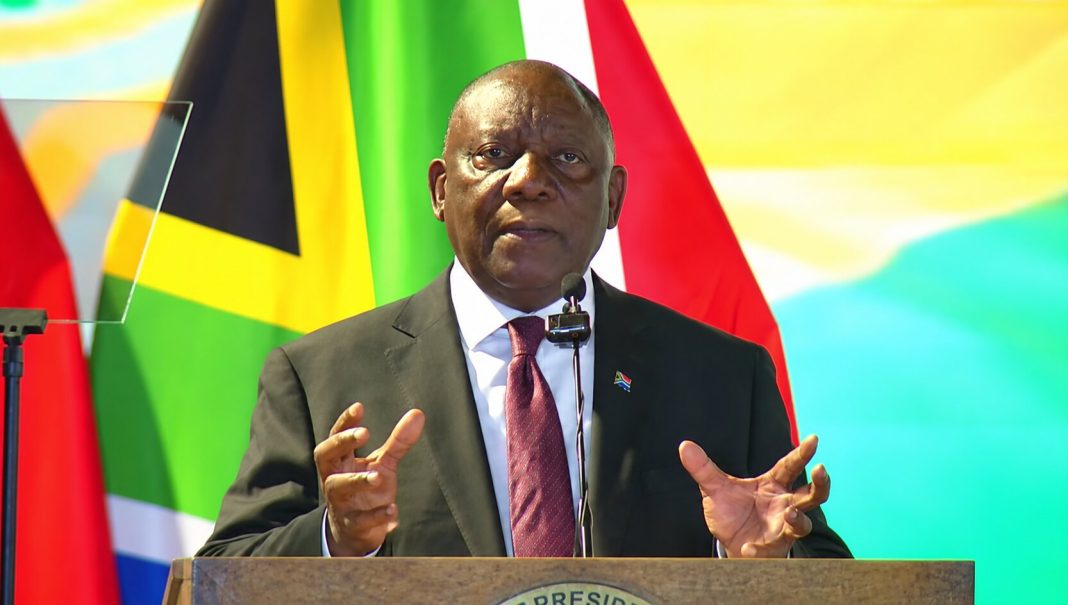
Delivering the keynote address at the launch in Ekurhuleni on Thursday, Ramaphosa said the reforms would fundamentally change how municipalities were structured, financed, managed and held accountable, while strengthening cooperation across all three spheres of government.
“The White Paper sets out to tackle dysfunction by reforming the entire system, not merely by responding to its symptoms,” he said.
The reforms come amid persistent problems with unreliable basic services, deteriorating infrastructure, financial mismanagement, corruption and weak administrative capacity across municipalities, nearly three decades after the adoption of the original White Paper in 1998.
Ramaphosa said the review had identified systemic weaknesses that could not be resolved by focusing on individual municipalities in isolation.
The first reform would reconsider how responsibilities are allocated between municipalities and other spheres of government, recognising that municipalities have different levels of revenue, expertise and institutional capacity.
He said the existing one-size-fits-all approach to municipal powers and functions needed to be reviewed, with responsibilities aligned more closely with each municipality’s ability to perform them.
“Where a municipality is unable to carry out a particular responsibility, that responsibility should be assigned elsewhere. In many cases, service provision would be better undertaken at a regional scale, or through partnerships and concession arrangements,” he said.
The White Paper also proposes separating the roles of service authority and service provider, alongside compulsory licensing for water and electricity providers. The aim is to strengthen regulation while expanding support to municipalities, particularly in delivering essential services.
Ramaphosa said national and provincial governments could not distance themselves from municipal failures, adding that clearer responsibilities and earlier intervention were needed when performance deteriorated.
The second reform would treat local government as an integrated system, requiring national departments, provincial governments, municipalities and state-owned entities to coordinate their planning, budgets and investments around shared priorities.
Building on the District Development Model, the policy seeks to address fragmented oversight, overlapping mandates and poorly coordinated interventions that have undermined service delivery.
The third reform focuses on municipal financial sustainability and infrastructure maintenance, with stronger financial management, improved revenue collection, reduced losses and more responsible spending among the proposed measures.
Ramaphosa said municipalities owed Eskom more than R120-billion, while many were also in arrears to water boards.
He said municipalities had too often neglected existing infrastructure while pursuing new projects. Revenue generated from water and electricity services would be ring-fenced to prioritise infrastructure maintenance.
The fourth reform would professionalise municipal administrations, strengthen institutional capacity and improve accountability among political leaders and officials.
Ramaphosa said appointments needed to be based on competence and commitment to public service, while political leaders had to respect the lawful responsibilities of professional administrators.
“There must be consequences when public resources are stolen, procurement is manipulated or public duties are neglected,” he said.
The policy also seeks to strengthen community participation, moving beyond consultation exercises towards meaningful involvement in municipal decisions and oversight.
“Trust will not be restored by speeches. It will be restored when a reported fault is fixed promptly. When a resident receives an honest response to a complaint. When municipal leaders account openly for their decisions,” Ramaphosa said.
The fifth reform places economic growth at the centre of local government, recognising that reliable municipal services and effective planning are essential for investment, entrepreneurship and employment.
Ramaphosa said municipalities needed to work with businesses and communities to create conditions for economic development, while improving land-use planning, transport and the reliability of water and electricity supplies.
The White Paper also calls on municipalities to plan for climate-related risks, including floods, droughts and fires, which place increasing pressure on communities and infrastructure.
The revised policy follows a review initiated by Cabinet in 2022 and builds on the Presidential Local Government Summit, stakeholder consultations and research into the performance of the existing system.
The February 2026 draft said the review had received 266 public submissions following the publication of a discussion document in April 2025.
The original 1998 White Paper sought to establish democratic, accountable and developmental local government following apartheid’s racially fragmented municipal system.
While access to basic services has expanded since 1994, the revised policy acknowledges that municipal performance remains uneven, with governance weaknesses, financial pressures and deteriorating infrastructure reinforcing one another.
Implementation will be phased and supported by a time-bound Local Government Transition Management Body, with coordinated leadership from the Department of Cooperative Governance, the Presidency and National Treasury.
A single transition plan will outline responsibilities, sequencing and measures to track progress.
Ramaphosa said some reforms would require legislative changes, new financing arrangements and potentially constitutional amendments.
With local government elections scheduled for early next month, he urged political parties to ensure that disagreements did not stand in the way of essential services.
INSIDE POLITICS






