



Sweden may face a long wait for a new government as preliminary election results on Monday showed a thin and still-uncertain lead for the left-leaning opposition, while a hard-right anti-immigration party saw its support slip.
With nearly 95% of districts counted, the Swedish Election Authority reported that the four opposition parties were heading for 176 seats in the 349-seat parliament in Stockholm, the Riksdag, with 173 seats going to the four parties that make up or support the outgoing conservative-led government.
But the outcome may not be clear until early votes, including overseas ballots, which didn’t make it to polling stations by Election Day, are counted on Wednesday.
It could be much longer until it’s clear who will run NATO’s newest member for the next four years. Sweden, a country of about 10.6 million inhabitants, is also a member of the European Union.
Negotiators will have to overcome red lines
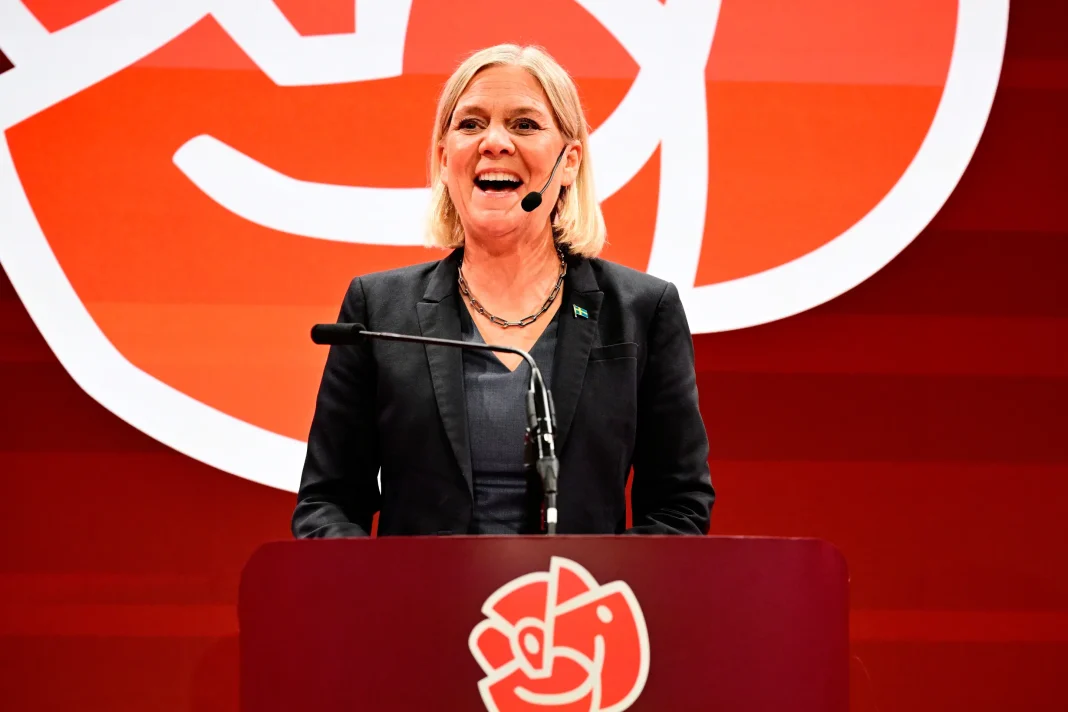
Former Prime Minister Magdalena Andersson’s center-left Social Democrats were set to finish as the biggest single party, despite losing some support, and Andersson hopes to win back the job she lost in 2022.
But if the left-leaning parties do emerge with a majority, she will face a complicated task to translate it into a government because of tensions within that bloc.
Current Prime Minister Ulf Kristersson remarked that “if all the red lines remain in place, then Sweden won’t have a government at all,” public broadcaster SVT reported. He added that he intends to “explore a number of possibilities that may exist.”
Mikael Damberg, a prominent Social Democrat, said that “all parties will have to do some giving and taking, and we will do that too,” Swedish news agency TT reported.
Kristersson has led Sweden since 2022 with a three-party center-right coalition.
It relied on outside support from the Sweden Democrats, an anti-immigration party that has far-right roots but has moved toward the political mainstream, for a parliamentary majority.
Kristersson had held out the prospect of Cabinet seats for the Sweden Democrats this time — if the governing coalition won.
Still, their performance was disappointing: preliminary results showed their support slipping to just under 18%, down about 3 percentage points from four years ago, and they fell behind Kristersson’s Moderates to land in third place.
“In Sweden, there has been a tradition of quite rapid government formations, but for the last 10 years they have turned more complicated, and this will be the case this year as well,” said Ann-Cathrine Jungar, a political science professor at Södertörn University.
AP






