



By Thapelo Molefe
The Inkatha Freedom Party (IFP) has pledged to enforce zero tolerance for corruption in municipalities, protect whistleblowers and strengthen the role of traditional and Khoisan leaders in local government.
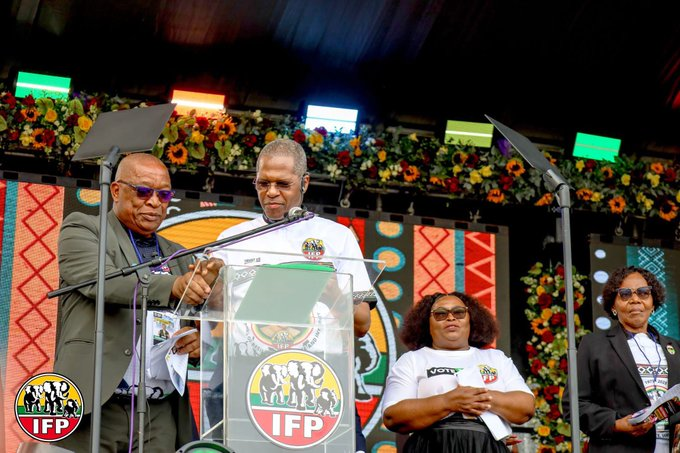
IFP president Velenkosini Hlabisa made the commitments on Sunday while unveiling the party’s five-point manifesto for the 2026 Local Government Elections at Princess Magogo Stadium in KwaMashu, Durban.
Hlabisa said municipalities could not improve service delivery without addressing corruption, poor financial management, tender manipulation and maladministration.
“Every rand entrusted to a municipality belongs to the people of South Africa. It must be used lawfully, efficiently and in the interest of community,” he said.
The party’s fourth manifesto commitment is focused on ending corruption, improving financial management and making municipal leadership accountable for performance.
Hlabisa said allegations of corruption, fraud, tender manipulation, theft and the misuse of public resources should be referred promptly for investigation and appropriate action.
He said the IFP had previously recalled mayors and removed councillors when consequence management was required and warned that the same approach would apply to its candidates.
“We have recalled mayors. We have fired counsellors because when consequence management has to be introduced to our public representatives, we do not hesitate,” Hlabisa said.
The party said councillors and municipal officials who break the law or fail to perform should face disciplinary action, including dismissal where appropriate and where wrongdoing is established.
The IFP also wants municipalities to develop a performance culture in which senior managers and municipal employees are held accountable for measurable results.
It plans to pursue the lawful recovery of money lost through misconduct, negligence and unlawful decisions.
Procurement processes would also be subject to greater scrutiny under the party’s plan.
The IFP said municipal procurement should be fair, competitive, cost-effective and transparent, while contracts should be monitored against agreed standards for cost, quality and delivery.
The party also wants municipalities to publish budgets, tenders, expenditure reports, service delivery standards and performance results in accessible formats, subject to applicable laws.
Hlabisa said transparency should extend to protecting people who report wrongdoing.
“Employees, councillors and residents who report wrongdoing in good faith must not be intimidated, victimised or punished for telling the truth,” he said.
The IFP also wants key municipal administrative positions to be filled through merit-based appointments.
Hlabisa said municipalities needed competent professionals with skills in areas such as planning, finance, infrastructure development and maintenance.
He also criticised political appointments in local government, saying municipalities needed to rebuild their internal capacity.
“Cadre deployment must be thrown away in our local government system in order to make our municipalities functional,” he said.
The party further committed to making councillors more accessible to residents.
Hlabisa said IFP councillors should remain present in their wards, report regularly to residents and be trained to understand municipal budgets, legislation and their oversight responsibilities.
The manifesto also calls for reforms to local government funding arrangements so that municipalities receive funding that is realistic, sustainable and appropriately matched to their responsibilities.
Hlabisa said accountability should apply to both political representatives and municipal officials.
“Our people cannot wait for their services because of incompetent counsellors and officials,” he said.
The party’s third commitment is to strengthen the participation of traditional and Khoisan leaders in local government and community development.
Hlabisa said traditional and Khoisan institutions should be recognised as meaningful partners in governance, particularly in rural and historically marginalised communities.
“Our traditional and Khoisan leaders must not be the afterthought,” he said.
The IFP wants municipalities to establish formal cooperation arrangements with legally recognised traditional and Khoisan leaders.
It said these leaders should be involved in designing, approving and driving social and economic development programmes in municipalities.
Hlabisa said the party would also pursue constitutional, legislative and policy reforms to clarify and strengthen the roles, powers and status of traditional and Khoisan leadership.
The IFP wants changes to Chapters 7 and 12 of the Constitution to be pursued at national government level.
“Our traditional institution must be involved in co-designing, in co-signing and co-driving social economic development programmes in our municipalities,” Hlabisa said.
The party said traditional and Khoisan leaders should receive adequate administrative, financial and technical support to perform their roles.
Hlabisa said their involvement was particularly important in ensuring that government policies reflected the realities of rural communities.
INSIDE POLITICS






