



By Thebe Mabanga
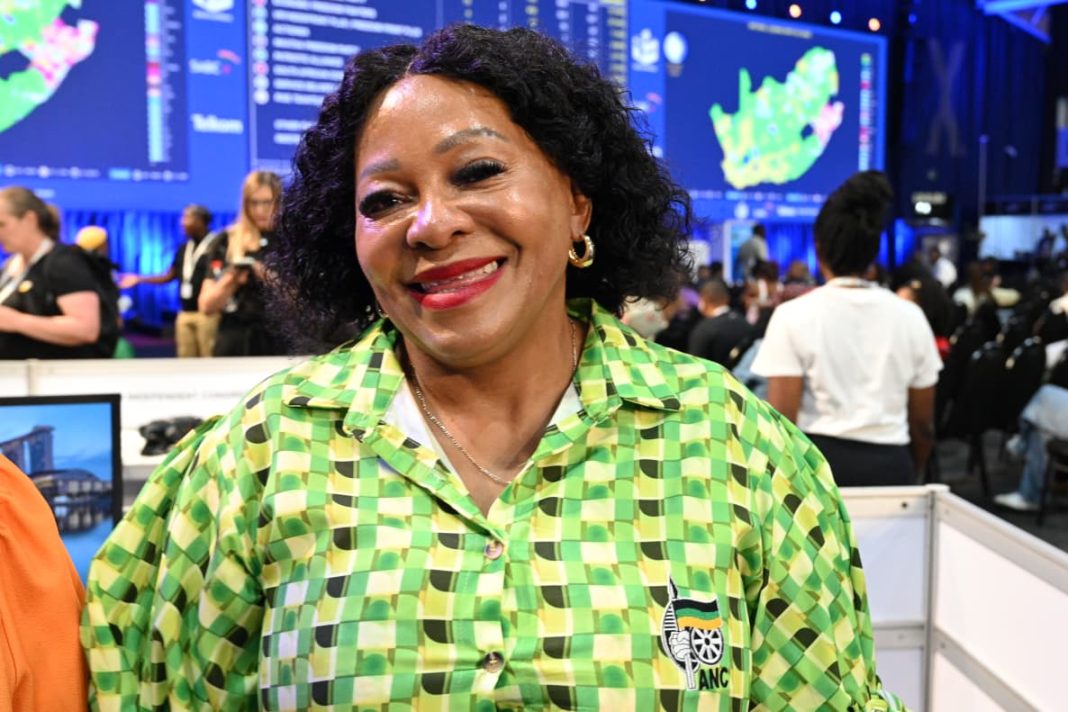
With just under half the votes counted, ANC first deputy secretary-general Nomvula Mokonyane remained defiant in the face of the party’s electoral decline, choosing instead to focus on its campaign performance and renewal agenda.
She also indicated that the ANC’s relationship with the Democratic Alliance (DA) in the Government of National Unity (GNU) would be reviewed, saying “nothing is sacrosanct”.
With 47% of the votes counted, the ANC stood at 32.01%, with 840 seats, while the DA had 26.32% and 487 seats.
The uMkhonto weSizwe Party (MK Party) had 7.54% of the vote and 119 seats. However, it was in the key metros that the ANC suffered some of its most significant losses.
In the City of Johannesburg, the DA stood at 38.96%, while the ANC had 17.52% and ActionSA 16.54%.
In Tshwane, the DA led with 33.86%, followed by ActionSA at 22.58% and the ANC at 20.34%. In Ekurhuleni, the DA had 36.54%, the ANC 18.89% and ActionSA 16.13%.
The ANC also lost wards such as Jabulani in Soweto and Merafong in Mogale City to the Inkatha Freedom Party (IFP).
Both areas have large hostel populations. The DA was also leading in the Nelson Mandela Bay Metro in Gqeberha, Eastern Cape, while the two parties were tied at 33.37% in Mangaung Metro in the Free State.
In the 2021 local government elections, the ANC secured 45.59% of the vote, followed by the DA with 21.62% and the Economic Freedom Fighters (EFF) with 10.32%.
Addressing the media at the National Results Operations Centre in Midrand, Mokonyane put on a brave face, choosing to focus on a few positives, including the ANC’s overall national lead.
She argued, without providing context, that had these elections been held in 2024, when the ANC lost its parliamentary majority, the party would have performed even worse.
Instead, Mokonyane maintained that the party’s renewal agenda was “ongoing”, pointing to its decision to open up the selection of ward councillor candidates to community members as evidence of progress.
She claimed that “99%” of the ANC’s ward councillor candidates came from communities and were not necessarily ANC members. She did not provide figures to substantiate the claim.
Mokonyane rejected suggestions that the results marked the beginning, or rather the continuation, of a decline similar to that experienced by other liberation movements on the continent.
She pointed instead to countries such as Brazil and Nicaragua.
The comparison with Brazil, where Luiz Inácio Lula da Silva’s Workers’ Party secured a narrow second-round victory against far-right challenger Jair Bolsonaro, was not entirely clear.
The reference to Nicaragua’s Daniel Ortega and the Sandinista National Liberation Front was similarly difficult to establish.
Mokonyane offered an olive branch to potential coalition partners, pointing out that the ANC had a “rich history of working with other parties” and that it would not attach conditions to negotiations.
Ahead of the press conference, Inside Politics learnt that the ANC had received an offer from the DA to relinquish Nelson Mandela Bay, Buffalo City and Mangaung in exchange for the three Gauteng metros. Mokonyane dismissed the claim as “gossip”.
Coalition negotiations are conducted at national level, with the ANC’s process led by its top seven officials.
Mokonyane said the party’s top officials met regularly, with the National Working Committee having met on Tuesday.
She said the party would receive a comprehensive briefing on the election results, including through the National Executive Committee, before mapping out the way forward.
Asked whether the ANC would review its relationship with the DA in the GNU, as promised by secretary-general Fikile Mbalula following a recent Constitutional Court ruling on the registration of party candidates, Mokonyane was unequivocal.
“Everything is up for review, nothing is sacrosanct,” she said.
Mokonyane also identified the South African Communist Party (SACP) as another organisation with which the ANC would need to engage.
The SACP contested the elections independently and, with 46% of the votes counted, had secured 300,000 votes and 29 seats nationally, representing 2.61% of the vote.
“The SACP is another party we will have a talk with. We did not go into the elections as an alliance,” she said.
Vote counting is expected to continue into the weekend.
INSIDE POLITICS






