

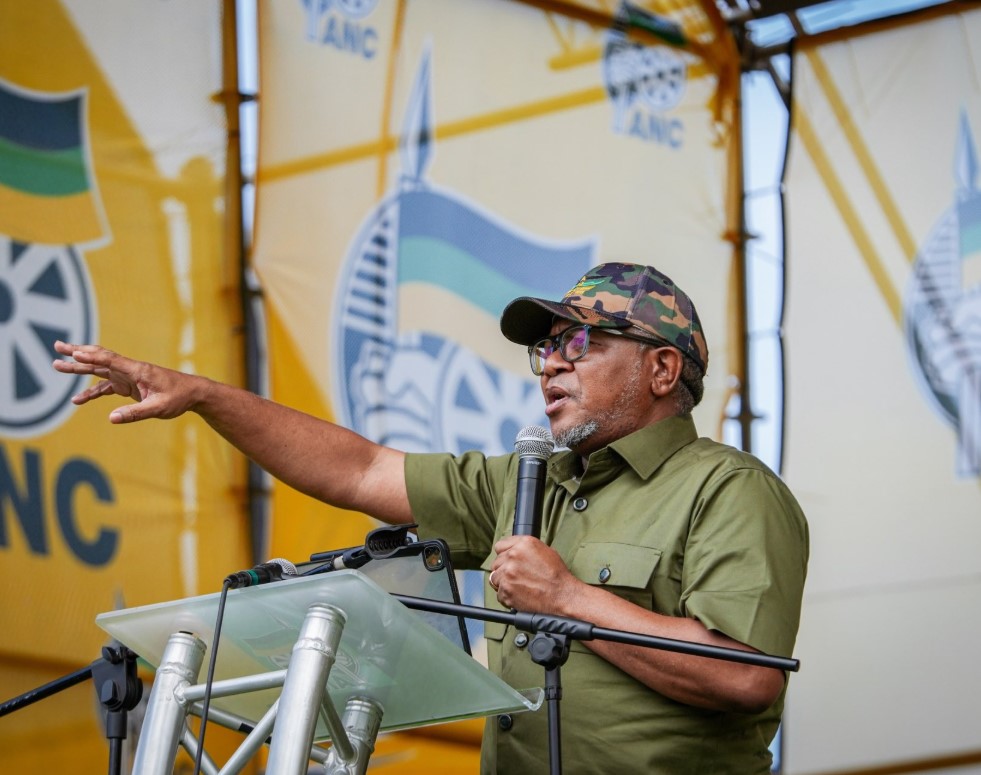


By Simon Nare
ANC secretary-general Fikile Mbalula has described the party’s performance in Wednesday’s local government elections as “catastrophic” after its national support plunged to a record low of about 30.89%.
The final results are scheduled to be released at 6pm on Sunday.
Mbalula, speaking at the Independent Electoral Commission’s results operation centre (ROC) on Saturday, acknowledged that some party supporters had abandoned the ANC and chosen to vote for other parties, while others had opted not to participate in the elections. He said the party would go back to basics to win back its support.
He said voters had spoken through the ballot and “if we fail to learn anything from these elections, we will never learn anything”.
“And if anyone has not heard what the people are saying through this election, then we are lost. This has been a very catastrophic outcome for the ANC. That we say plainly. As much as we are the largest party, it has been catastrophic for the movement.
“The ANC must never be comfortable about this particular space we are in. We have worked tirelessly. We told [ourselves] that we will be at 34%. We knew what was happening. It’s not that we didn’t. We knew and we put up a fight. We ran a wall-to-wall campaign to push back,” he said.
READ: Malema blames ANC-DA coalition for strengthening ‘white supremacy’ as EFF reels from election losses
Mbalula said that, as the country headed into the elections, the cost of living had risen and middle-class voters had turned their backs on the ANC “in big numbers”, particularly in Soweto and Tshwane, where many voted for ActionSA.
He said the party had lost hope in KwaZulu-Natal following the emergence of former president Jacob Zuma’s uMkhonto weSizwe Party, but the results in the province had shown promising signs that the ANC was steadily regaining support.
He said the party had made the right call in Tshwane by requesting recounts in wards initially won by ActionSA, which the ANC subsequently won following the recounts. He said that the recounts should not be interpreted as evidence that the elections were not free and fair.
“If we didn’t learn from this election catastrophic disaster and allow wrong things to continue then we wouldn’t have learnt at all. So, we have a mandate from now. On Monday we will finalise through the officials a detailed analysis of this election,” he said.
He said that the party’s national executive committee (NEC) would meet at the end of the week to provide guidance on its approach to coalition negotiations in hung municipalities.
He said the ANC would continue engaging other parties in preliminary coalition discussions and listen to those that had already made decisions on potential partnerships.
He acknowledged that some parties were determined to exclude the ANC from governing municipalities, but said the party would fight to recover from “this set back”.
“There are people who went to the polls to punish us, but this African National Congress is still around. They wanted us out completely, but we are still around. But we don’t read that punishment as anything else other than a warning to the ANC.
READ: Zuma takes full control of MK Party coalition talks, demands final say on all deals
“There are many things that went wrong under our watch and leadership where we govern. Even though we governed through a coalition, people judged us harshly and that too is a lesson,” he said.
Mbalula said that, as the party prepared to engage in coalition negotiations, it needed to reflect on its experiences over the past five years, assess what had been achieved and determine its approach going forward.
He said becoming a principled opposition was also an option, but these questions would be addressed in a coalition “doctrine” to be drafted on Monday, presented to the NEC and subsequently shared with the public once the party had adopted a position on coalition governments.
He said he could not immediately explain how the ANC intended to turn its fortunes around, as the party still needed to analyse its electoral performance and determine what had led to its loss of support before deciding how to fight back.
He said voter turnout had been a major factor in the results, pointing out that DA supporters had turned out in large numbers, contributing to the party’s performance, while turnout among ANC supporters had been comparatively low.
INSIDE POLITICS






