



By Thapelo Molefe
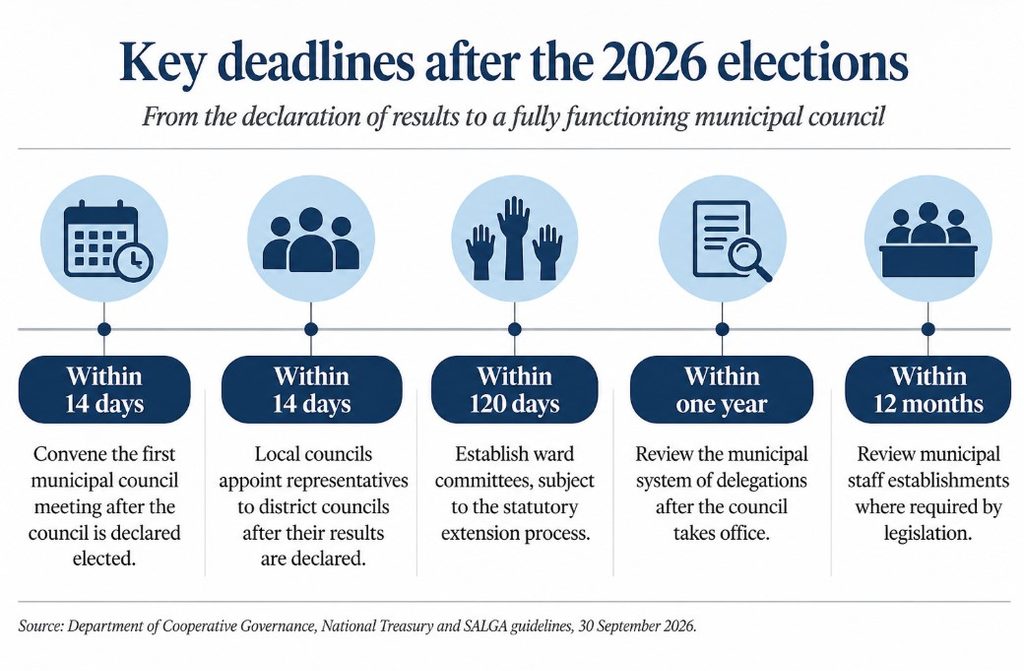
South Africa’s newly elected municipal councillors have just 14 days after their councils are declared elected to hold their first meetings and begin electing political leaders following the 2026 Local Government Elections.
With the Electoral Commission of South Africa (IEC) expected to announce the final election results on Sunday, 8 November, attention is shifting from the ballot box to the formation of municipal governments, particularly in councils where no political party has secured an outright majority.
The Department of Cooperative Governance, National Treasury and the South African Local Government Association have issued joint guidelines explaining how municipalities must manage the transition.
Signed on 30 September, the guidelines set out the legal deadlines for establishing councils, electing mayors and Speakers, negotiating coalitions and handing over municipal responsibilities.
Here is how the process works.
How long do municipalities have to establish their councils?
Under Section 29(2) of the Local Government: Municipal Structures Act, municipal managers must convene the first meeting of a newly elected council within 14 days after the council has been declared elected.
If the legally applicable declaration date is Sunday, 8 November, the first meeting must therefore take place by Sunday, 22 November.
Importantly, the deadline is calculated from the date each council is formally declared elected, rather than automatically from the date of the IEC’s national results announcement.
The municipal manager is responsible for convening the meeting. If the municipality does not have a municipal manager, the provincial MEC responsible for local government must designate someone to perform this function.
The first meeting may take place physically, virtually or through a hybrid arrangement, provided it complies with legislation and the municipality’s standing rules.
For district municipalities, the 14-day period begins once all representatives appointed by local councils have been confirmed.
How are mayors and speakers elected?
Unlike national and provincial elections, where voters elect representatives to legislatures, municipal voters do not directly elect their mayors.
Instead, voters elect municipal councillors, who are responsible for choosing the municipality’s political leadership.
At the first council meeting, councillors must elect a speaker, who presides over council proceedings and ensures that meetings comply with the applicable rules.
The process for electing the mayor depends on the executive system used by the municipality.
In municipalities operating under an executive mayoral system, councillors elect the executive mayor, who appoints the Mayoral Committee in accordance with the law.
Municipalities using a collective executive system have an Executive Committee, with seats allocated according to a prescribed formula reflecting political representation in the council. The municipal council then elects the mayor from among the Executive Committee’s members.
Deputy office-bearers are also elected where applicable.
The election of political office-bearers takes place under the procedures prescribed by the Municipal Structures Act.
What happens if no party wins an outright majority?
A municipality is considered politically hung when no party holds more than half the council seats.
For example, in a council with 100 seats, a party needs at least 51 seats to command an outright majority.
Where no party reaches this threshold, political parties may negotiate coalition agreements to establish a governing majority.
These agreements can determine which parties will support a mayoral candidate, how political responsibilities will be distributed and what policy priorities the incoming administration will pursue.
A coalition agreement does not itself elect a mayor or establish a council’s political leadership. The relevant decisions must still be taken through the council’s formal voting procedures.
A party could also secure a mayoral position through support from councillors outside a formal coalition, although such an arrangement may leave the administration vulnerable to future votes of no confidence.
Following the 2021 Local Government Elections, 76 municipalities came to be governed through coalition arrangements.
The government’s latest guidelines encourage political parties to conclude negotiations as early as possible to avoid prolonged uncertainty.
They also emphasise that coalition agreements cannot override the Constitution, the Municipal Structures Act, the Municipal Systems Act or the Municipal Finance Management Act (MFMA).
Can coalition negotiations delay the first council meeting?
No. Coalition negotiations do not suspend the statutory deadline for convening the first council meeting.
Political parties may continue negotiating arrangements, but municipal managers remain responsible for ensuring that the council meets within the prescribed period.
This means parties could enter their inaugural council meetings without finalised coalition agreements.
They would still need to participate in the statutory processes for electing office-bearers.
The guidelines also prohibit municipal managers and other officials from participating in, facilitating or influencing coalition negotiations.
Municipal vehicles, facilities, communication systems and public funding may not be used for political party negotiations.
What happens if councillors cannot agree on a mayor?
In politically divided councils, competing candidates could receive the same number of votes during the election of political office-bearers.
The Municipal Structures Act provides procedures for resolving tied votes to prevent deadlocks from indefinitely delaying the election of municipal leaders.
These procedures can include further rounds of voting and, where prescribed, the drawing of lots to determine the outcome.
The applicable procedure depends on the office being filled and the relevant provisions of the Act.
This means that even where political parties cannot agree on a coalition or a preferred candidate, the legislation provides mechanisms for resolving tied election outcomes.
What happens to municipal services while councils are being formed?
Municipal administrations remain responsible for maintaining essential services throughout the transition.
Municipal managers, Chief Financial Officers and senior officials continue performing their administrative responsibilities even as the political leadership changes.
This includes maintaining water and electricity services, waste collection, financial administration and existing municipal programmes.
The government’s guidelines require outgoing administrations to prepare two separate handover reports.
The political report must outline the outgoing council’s performance, outstanding governance challenges and, where applicable, lessons learnt from coalition arrangements.
The administrative report must provide incoming councillors with information about municipal finances, infrastructure, service delivery backlogs, audit outcomes and outstanding financial commitments.
These reports must be submitted to provincial cooperative governance departments, National Treasury, DCoG and SALGA before the first council meeting.
How are district municipal councils established?
District municipalities follow a slightly different process because their councils include representatives appointed by local municipalities.
Under the Municipal Structures Act, local councils must appoint their representatives to district councils within 14 days after their election results have been declared.
Once all appointed district representatives are in place, the district municipal manager has a further 14 days to convene the district council’s first meeting.
The timing of district council formation therefore depends partly on how quickly the constituent local councils complete their appointments.
What other deadlines must new councils meet?
The establishment of political leadership is only the first step in the transition. New councils must also meet several statutory and administrative deadlines. These deadlines are measured from different legal trigger dates and do not all begin on the national results announcement date.
Ward committees are important because they provide residents with a formal channel to raise service delivery concerns and participate in municipal planning.
Under Section 73 of the Municipal Structures Act, metropolitan and local councils must establish ward committees within 120 days after the election of the municipal council.
If a municipality cannot establish its ward committees within the prescribed period, the Speaker must apply in writing to the provincial MEC responsible for local government for an extension before the deadline expires.
New councils must also consider their Integrated Development Plans (IDPs), which determine municipal development and service delivery priorities.
They may retain existing plans or initiate amendments, provided these comply with the Municipal Systems Act.
Municipal staff establishments must also be reviewed within 12 months where required by the applicable regulations, including circumstances involving the election of a new council, the adoption of a new IDP, significant changes to municipal functions or changes to municipal boundaries.
What happens after the new councils take office?
The incoming political leadership will inherit responsibility for municipal budgets, infrastructure programmes, financial oversight and the provision of basic services.
The guidelines place emphasis on municipalities facing unfunded budgets, poor audit outcomes and growing debts to Eskom and water boards.
“Municipalities with unfunded budgets, adverse audit outcomes or persistent financial challenges may be subjected to interventions and funding-related measures in terms of applicable legislation. Municipalities must prioritise the payment of creditors, including Eskom and Water Boards, to avoid service disruptions and financial instability,” the document states.
New councillors will also undergo an induction programme coordinated by SALGA, Cooperative Governance, National Treasury and the National School of Government.
“The programme will provide incoming councillors with a broad overview of the municipal environment and will, inter alia, cover their roles and responsibilities; the policy and legal framework; and various municipal processes,” the document states.
Municipalities already under provincial intervention will remain subject to those arrangements, with further guidance expected from DCoG and National Treasury.
INSIDE POLITICS






