



By Johnathan Paoli
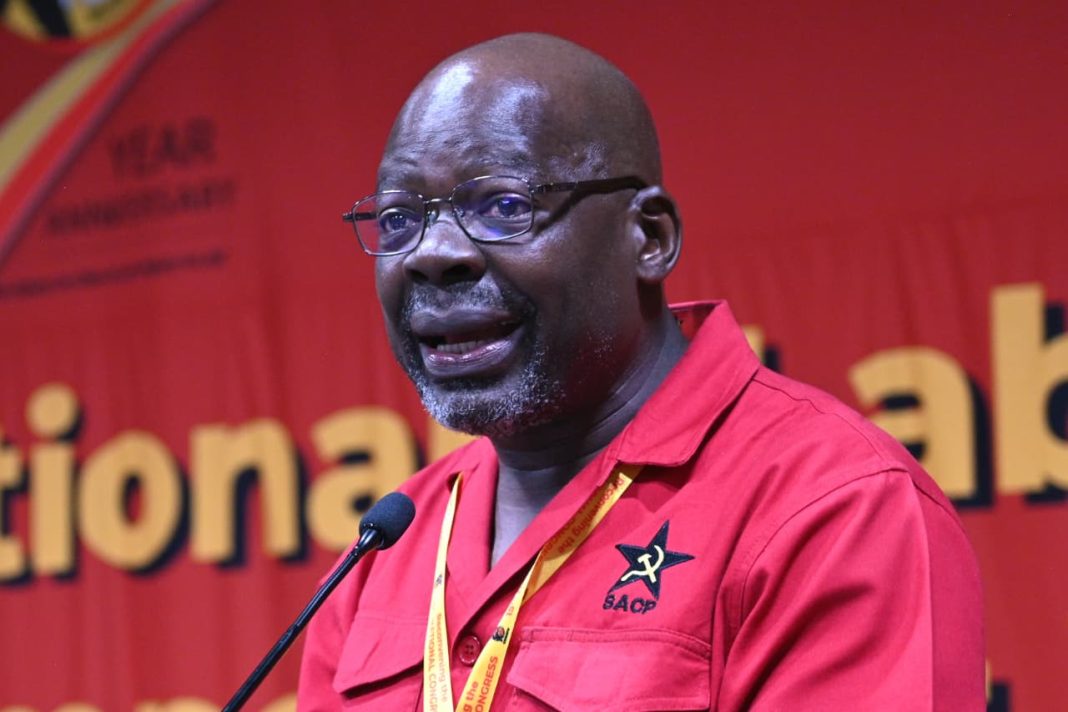
South African Communist Party (SACP) general secretary Solly Mapaila has credited the party’s grassroots mobilisation, community development initiatives and historical role in the liberation struggle for its performance in the 2026 Local Government Elections (LGE), saying the results had not come as a surprise.
The SACP, which contested elections independently on a large scale for the first time since it was banned under apartheid, said its campaign was built on self-reliance and practical interventions in communities rather than expensive political advertising and conventional electioneering.
“We want to express our deepest thanks to South Africans for coming out in their numbers to vote, and especially those who voted for the SACP. We are really humbled by this reflection,” Mapaila said during a media briefing on Friday.
He thanked the party’s Red Brigades and members who participated in the campaign despite having virtually no financial resources.
“It’s a product of people’s intervention and self-reliance of our communities and our cadres. And I think possibly the first entrant in this campaign that wins awards. Many others have won a lot of PR seats in the past, but we have gone in directly to take awards in different communities,” he said.
Mapaila said the party intended to respect the electoral support it had received and translate its representation into practical interventions, arguing that development should not depend exclusively on government.
He said the SACP had consistently advocated for organised communities to take responsibility for addressing local problems, pointing to initiatives undertaken by its members during the election campaign.
“We’ll continue to work with them and to make sure that development is not only reliant on governance, but we have said to them, development is reliant on an organised community. And it is that organised community that will sort out crises,” he said.
Mapaila cited the party’s Localised People’s Red Caravans, through which members continued working in communities, including on election day.
He said the initiatives included installing water pumps in informal settlements and removing accumulated rubbish without government involvement.
“We are doing it in one single week in different communities without the involvement of government. So this space to enter the governing space independently on behalf of the working class has become important for the SACP. And we’ll be speaking for communities and nobody else, for the working class, nobody else,” he said.
Asked what had persuaded communities to support a party contesting elections independently, Mapaila pointed to the SACP’s history of political exclusion.
He said the organisation’s participation in elections had been interrupted for 76 years following its banning in 1950 under the Suppression of Communism Act.
“Until now, we reconnected with that particular path. And of course, the biggest issue for us has been how our comrades have humbled themselves in communities, worked together with communities to find solutions of their problems,” he said.
Mapaila said the party had deliberately prioritised community development over campaign material, with some members wearing their own old T-shirts during the election campaign.
He said candidates had been given a choice between spending limited resources on campaign clothing or directing the money towards community projects, with most opting for the latter.
The party’s manifesto also emphasised practical problem-solving, with Mapaila recalling its position that communities should not repeatedly encounter the same unresolved problems.
“We are not the kind of people that see a pothole more than twice. If you pass it once, when you see it for a second time, you then create a solution to resolve it,” he said.
He also credited the SACP’s historical association with the liberation movement, particularly the legacy of former general secretary Chris Hani, saying the party had dedicated its election campaign to the assassinated leader.
Mapaila said the party’s immediate objective was to develop a common political strategy, particularly around service delivery and direct budgeting for communities, before pursuing possible collaborations with other parties.
The party’s Politburo was expected to meet on Monday to finalise the framework guiding the discussions, which are being facilitated by deputy general secretary Madala Masuku.
Mapaila also addressed complaints from party structures about aspects of the voting process, saying the SACP’s legal team was handling technical matters through the appropriate electoral channels.
Although he expressed disappointment with the handling of procedures by some presiding officers at voting stations, he maintained that the elections had generally been orderly and successful.
Asked whether the party had been surprised by its electoral performance, Mapaila rejected the suggestion, saying the SACP had maintained a consistent presence in communities long before entering the electoral contest independently.
“We’re not surprised by our performance. Certainly, it’s those people that have never followed the Communist Party. We work in our communities consistently,” he said.
With counting continuing, the SACP had secured 585,295 votes, representing 2.49% of valid votes nationally, and 125 council seats.
Its strongest provincial support was in the Eastern Cape, where it recorded 6.17%, followed by North West at 4.27%, Limpopo at 4.19% and Mpumalanga at 3.83%.
The party had also secured representation across all nine provinces.
INSIDE POLITICS






