
By Johnathan Paoli
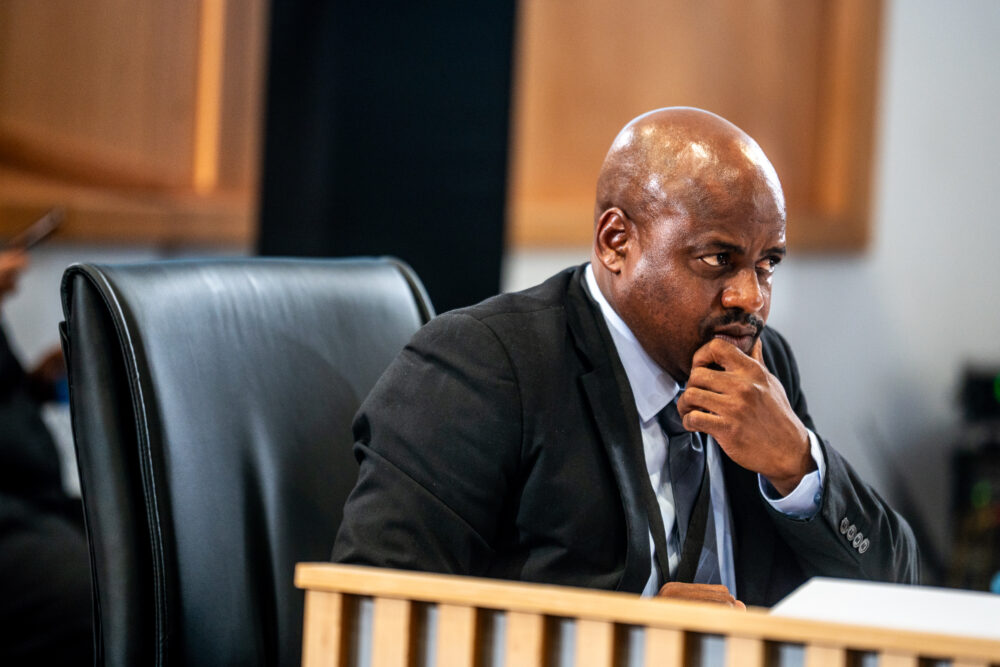
Suspended Ekurhuleni Metro Police Department (EMPD) Deputy Chief Julius Mkhwanazi has told the Madlanga Commission of Inquiry that the EMPD has routinely conducted operations outside its jurisdiction since its formation, conceding under questioning that such actions are not always explicitly authorised by existing agreements.
Addressing his supplementary statement on Tuesday afternoon, Mkhwanazi said cross-boundary operations were longstanding practice within metro policing, driven by the geographic layout of Gauteng municipalities and the need for coordinated crime-fighting.
“EMPD has been conducting operations outside its jurisdiction, both nationally and provincially, since its formation in 2002, including the tracing of most-wanted suspects and the execution of warrant arrests,” his affidavit read.
He said that the proximity of municipalities often created operational “grey areas”.
“The City is separated or divided by one street, with other municipalities that are surrounding it,” he added.
Mkhwanazi pointed to memoranda of understanding (MOUs) with other metro police departments and the NPA as the basis for such operations.
However, under sustained questioning from evidence leader advocate Mahlape Sello, Mkhwanazi conceded that these agreements do not explicitly grant EMPD officers the authority to operate independently outside their jurisdiction, but insisted that it does not forbid it either.
The commission heard that a 2001 MOU, signed before the EMPD was formally established, was among the documents Mkhwanazi relied on to justify cross-jurisdictional operations.
Counsel pointed out that the agreement defined the “service provider” as the Johannesburg Metro Police Department (JMPD), not EMPD, raising further doubts about its applicability.
A more recent agreement, signed in April 2025, appeared to directly contradict Mkhwanazi’s position.
Clause 7.2.8 stipulates that metro police may only operate in another jurisdiction “during planned operations and for the duration of the operation”, while clause 7.2.9 requires coordination with the South African Police Service (SAPS).
Confronted with this, Mkhwanazi partially retreated from his earlier stance, admitting that EMPD officers continue to operate outside their jurisdiction on a daily basis, sometimes without formal coordination.
He said the EMPD has acted “a million times” acted without involving other police departments because they were “allowed to”, but said that unplanned operations only happen “sometimes”.
The issue forms part of broader allegations by former EMPD Deputy Chief Revo Spies, who claimed Mkhwanazi led unauthorised raids beyond Ekurhuleni’s boundaries during his tenure as acting head.
Asked directly whether he was authorised to apprehend suspects outside his jurisdiction, Mkhwanazi did not give a definitive legal basis, instead emphasising cooperation between agencies.
Commission chairperson Justice Mbuyiseli Madlanga asked whether EMPD officers could lawfully conduct operations in areas such as Soweto without being in “hot pursuit”.
Mkhwanazi responded that such cases had nonetheless been processed by the courts.
“In a court of law, the dockets from such operations have been accepted, we’ve been doing that,” he said.
On the handling of evidence, including stolen goods, Mkhwanazi said officers were required to book items at SAPS stations, underscoring the reliance on national police structures when operating beyond municipal boundaries.
Despite the legal ambiguities, Mkhwanazi maintained that cross-jurisdictional operations were a practical necessity and not unique to EMPD, saying that officers from other metros, including Johannesburg and Tshwane, similarly operate within Ekurhuleni.
His testimony highlights a central tension before the commission: the gap between formal legal frameworks governing metro policing and the operational realities on the ground.
INSIDE POLITICS



