


By Johnathan Paoli
The ANC has fallen to 18% support in Johannesburg while the DA holds a commanding lead on 42%, according to new polling conducted ahead of South Africa’s local government elections on 4 November.
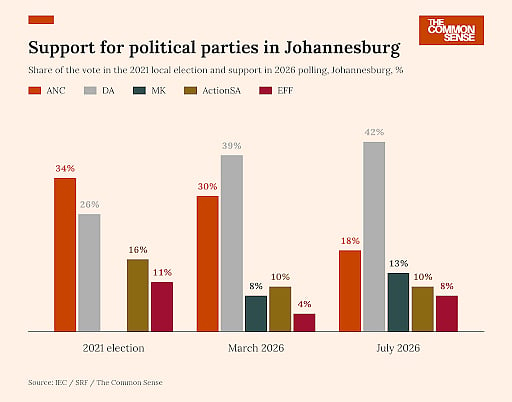
The Johannesburg survey covered 504 registered voters between 8 and 31 July and was conducted by Victory Research in conjunction with The Common Sense and the Social Research Foundation (SRF).
The metro results carry a stated margin of error of 4.4 percentage points at a 95% confidence level.
Behind the DA and ANC, the uMkhonto weSizwe Party (MKP) polled at 13%, ActionSA at 10% and the Economic Freedom Fighters (EFF) at 8%.
ALSO READ: Church leaders announce Limpopo march over alleged threats to religious freedom
The latest numbers point to a sharp deterioration in the ANC’s position since an earlier Johannesburg survey in March.
At that stage, the ANC stood at 30%, compared with 39% for the DA. ActionSA was on 10%, MKP on 8% and the EFF on 4%.
The ANC has therefore lost 12 percentage points between the two surveys, while the DA’s recorded support increased by three points.
MKP moved from 8% in March to 13% in the latest poll, while the EFF moved from 4% to 8%.
SRF Director of Research Gabriel Makin has pointed to the DA’s current position as particularly notable when measured against its previous Johannesburg local election results.
The DA secured 38.41% of the Johannesburg vote in the 2016 local government elections before dropping to 26.47% in 2021.
A polling level of 42% would therefore represent a considerable improvement on the party’s 2021 performance if similar levels of support were ultimately reflected at the ballot box.
Makin has attributed part of the DA’s showing to its Johannesburg campaign under mayoral candidate Helen Zille, saying that the party has placed greater emphasis on presenting its proposed remedies for the city’s problems.
The survey also gives an indication of the possible coalition arithmetic facing parties after the election, although voting-intention percentages cannot simply be converted into council seats.
The DA and ActionSA together account for 52% of support in the poll.
The ANC, MKP and EFF collectively stand at 39%, meaning those three parties would, on these numbers, require support from additional parties to reach a majority.
The Johannesburg findings were released alongside national polling conducted during the same period.
The national survey included 2,214 registered voters and carries a stated margin of error of 2.1 percentage points.
Nationally, the ANC polled at 34%, followed by the DA at 27%, MKP at 15%, the EFF at 7% and the Inkatha Freedom Party at 5%.
ALSO READ: KZN Political Killings Task Team takes over probe into murder of ANC eThekwini councillor
In March, the same polling series had placed the ANC nationally at 39%, the DA at 28%, MKP at 10% and the EFF at 6%.
The researchers have also examined voter attitudes towards immigration, an issue Makin believes could pose a significant political challenge for the ANC.
In one of the survey questions, 71% of respondents agreed with a proposition linking foreign immigration to difficulties South Africans face in finding employment, while 26% disagreed.
Makin has also cited recent political controversies, including developments around the Madlanga Commission and renewed attention on the Phala Phala matter, as possible contributors to changing perceptions of the governing party.
The ANC has made improving local government a central part of its election campaign but had, as of Fridy, not publicly named its Johannesburg mayoral candidate.
The DA is contesting Johannesburg under its “Believe in Joburg” campaign, with Zille as its mayoral candidate.






