



By Lebone Rodah Mosima
Political parties will be given direct access to the election results system for eight days next month to test it with their own independent experts ahead of the November 4 local government elections, IEC chairperson Mosotho Moepya said on Wednesday.
The Electoral Commission has completed end-to-end functionality testing of the system and will allow contesting parties access from 5 to 12 October to identify and raise potential problems before election day.
An unprecedented 136,790 candidates have been certified to contest 10,526 council seats across the country.
Speaking at the National Electoral Code of Conduct Signing and Ballot Paper Draw Ceremony at Gallagher Convention Centre in Midrand, Moepya said the IEC had also upgraded its voter management devices, including handheld scanners used to verify voters against the voters’ roll.
The devices had undergone internal and external stress testing to address technological problems identified during the 2024 elections, he said.
“In our commitment to transparency, the Commission will invite all contesting political parties to test the results system using their preferred independent experts,” Moepya said.
“Political parties will have direct access to the system from 5 to 12 October 2026 to identify, raise, and remediate any systemic issues well ahead of Election Day.”
The IEC said last week that external independent auditors had also been brought in to validate key controls, processes and functionality in the system used to collate and process election results.
Moepya said measures had also been introduced to improve the flow of voters through voting stations and reduce queues.
The commission has completed the recruitment and training of 23,696 presiding officers and 29,964 deputy presiding officers to oversee voting-station operations nationally.
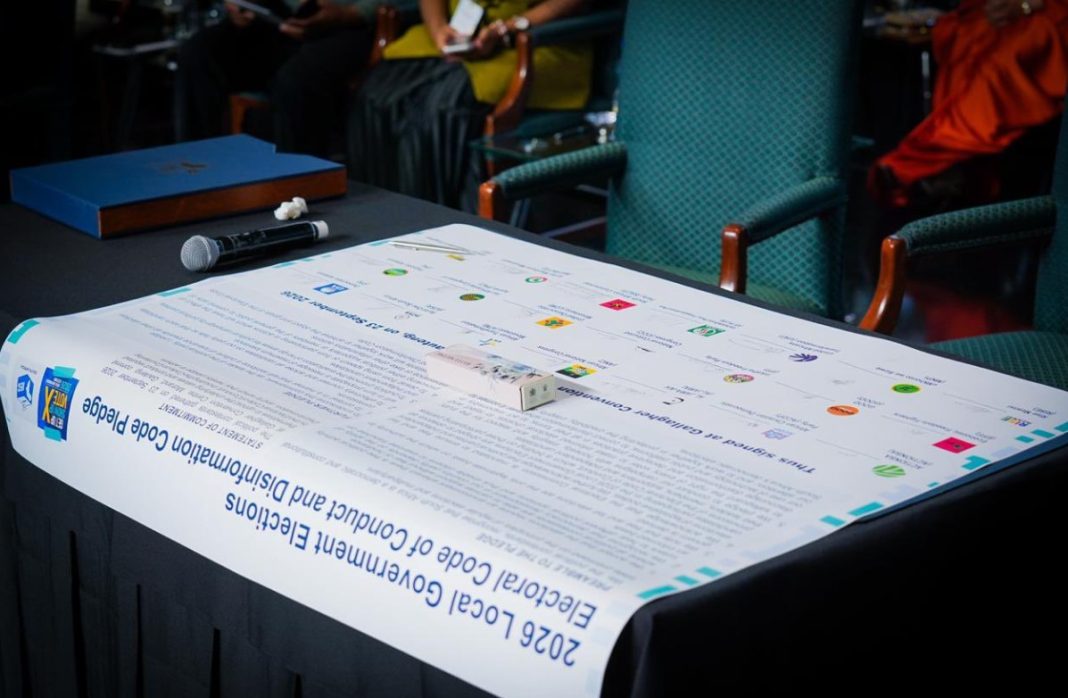
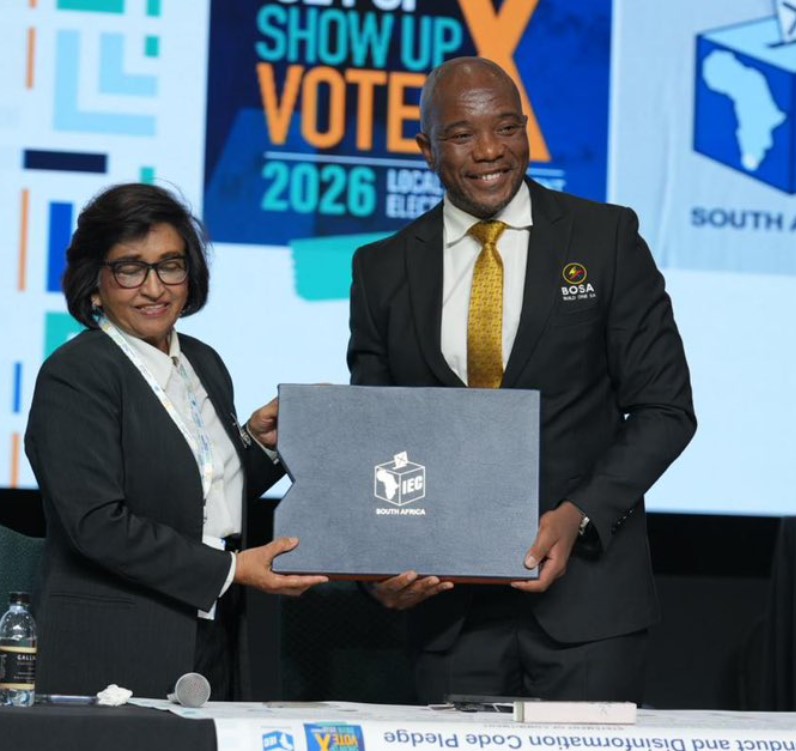
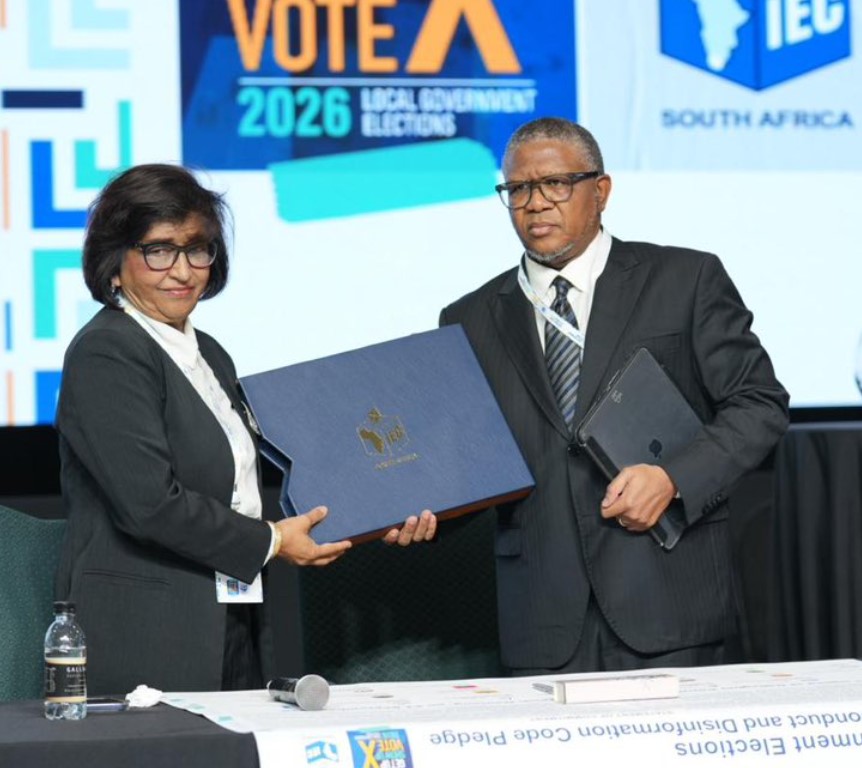
Wednesday’s ceremony also saw political parties commit themselves to the Electoral Code of Conduct.
“Signing the Electoral Code of Conduct is not merely a performative stage in our electoral timetable,” Moepya said.
“It is a sacrosanct ingredient in the Electoral Commission’s unyielding pursuit of electoral integrity, democratic consensus, and political peace.”
The IEC’s 2025/2026 Voter Participation Survey, conducted with the Human Sciences Research Council, found declining satisfaction with democracy and falling confidence in institutions including political parties, municipal councils and the Electoral Commission.
“Only 17% of adult South Africans express satisfaction with our democratic trajectory, while a staggering 68% feel actively dissatisfied,” he said, referring to the survey.
It also found that only 28% of adults in Gauteng regarded democracy as preferable to alternative systems of government.
“More alarmingly, in KwaZulu-Natal, adult support for democracy has collapsed precipitously from 54% in 2004 to just 6%,” Moepya said.
He said lower turnout among Millennials and Gen Z voters should not simply be attributed to apathy, with younger people continuing to value voting while questioning whether it produced meaningful change.
“However, 69% of youth respondents explicitly believe that their vote will not make a tangible difference, and 78% feel that all political parties become indistinguishable once elected,” he said.
Moepya said the findings were evidence of “profound structural disillusionment”, linked to unemployment, inequality and failures in local government.
“Against this backdrop of widespread public scepticism, the Electoral Code of Conduct is more vital, more relevant, and more urgent than ever,” he said.
Political parties are expected under the code to condemn political violence and intimidation, respect citizens’ rights to express their political beliefs without coercion and conduct campaigns focused on policies, ideas and service delivery.
Protection for journalists
Moepya also emphasised protections for journalists during the campaign.
“A foundational pillar of a free and fair election is an unhindered, independent press,” he said.
Under the code, parties and candidates may not prevent journalists from attending public political meetings, marches, demonstrations or rallies and must take reasonable steps to protect them from harassment, intimidation, threats and physical assault.
“No personal details or private information of a journalist — including their home addresses, personal contacts, or details of their loved ones — may be posted online,” Moepya said.
“Doxxing is a severe violation of human rights and electoral decency that can lead to physical harm.”
The IEC’s Electoral Code of Conduct Countering Disinformation in the Local Government Elections, promulgated on 4 September, requires contestants to verify information they distribute, correct false or misleading information within 36 hours of becoming aware of it and clearly label AI-generated campaign material.
The commission has designated Real411 as a platform for reporting suspected election-related disinformation.
“Disinformation starves the public of truth, thrives in information gaps, and actively destroys what remains of public trust. Free and fair elections rely entirely on procedural accuracy and credible information that shapes informed voter choices,” Moepya said.
Wednesday’s programme also included the ballot paper draw, which determines the order in which political parties appear on ballot papers.
The IEC will begin printing ballot papers following the draw for the 4,488 wards, up from 4,468 in 2021.
Political parties and independent candidates have been called on to inspect and sign sample ballot papers at their respective IEC local offices from 10am on September 25.
Moepya urged political leaders to use the election campaign to rebuild public confidence in democratic institutions.
“Give our people an election period characterised by peace, rigorous truth, and unyielding integrity,” he said.
INSIDE POLITICS






