



Simon Nare
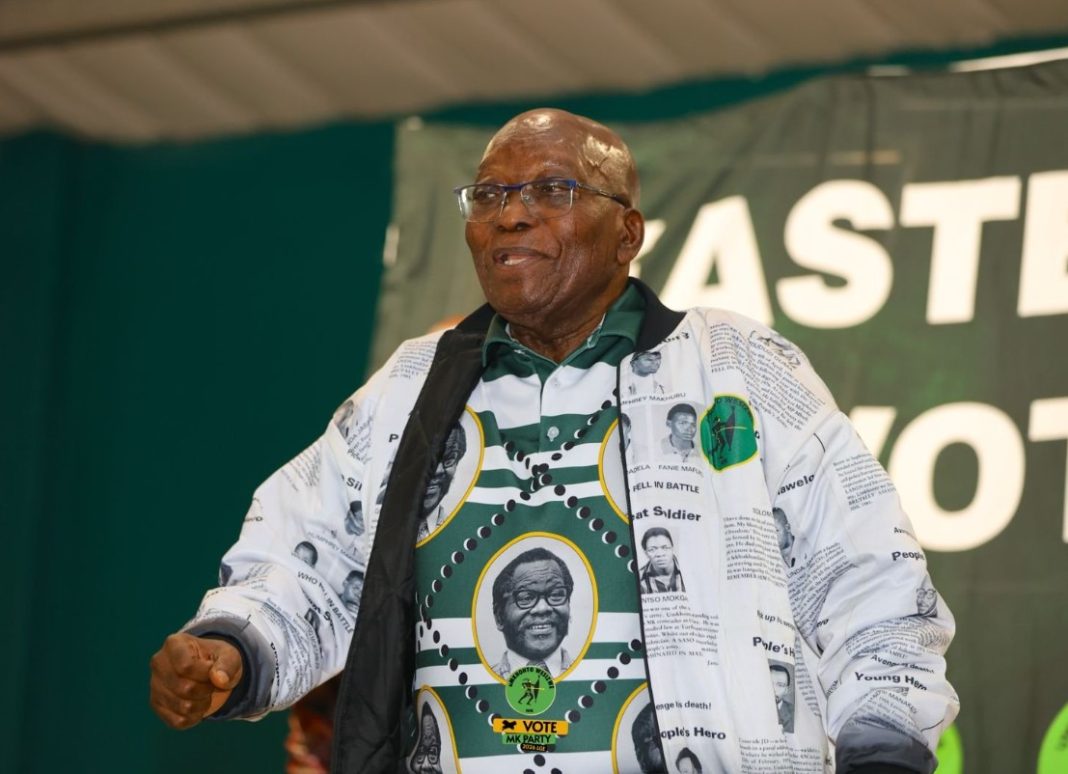
The uMkhonto weSizwe Party (MKP) leader, former president Jacob Zuma, has laid down the law on coalition negotiations by his party in hung municipalities following the local government elections on Wednesday, as he centralised the national framework and gave himself absolute power to sign all agreements.
Zuma, in a statement read out by Advocate Dali Mpofu at the provincial Results Operations Centre in Durban on Saturday, announced a seven-member team that will coordinate the negotiations and report to him directly.
READ: Horse-trading looms as hung councils soar after local elections
The team will be led by first deputy president Duduzane Zuma, one of Zuma’s children, and second deputy president Tony Yengeni.
It will comprise senior leaders such as national chairperson Apostle Nkosinathi Pakathi, acting secretary-general Lindiwe Mtshali, KwaZulu-Natal provincial chairperson Willies Mchunu, Mpofu and Dr Thanti Mthanti.
“The team is entrusted with the responsibilities of leading and coordinating all coalition negotiations on behalf of the MKP. The national team is mandated to engage prospective coalition partners, assess political and programme alignment, negotiate coalition agreements and make recommendations on governance arrangements and the distribution of the executive responsibility,” said Zuma.
The line of march dictated that all negotiations must be guided by the party’s people’s mandate and its approved coalition negotiations manual, an internal document.
In the negotiations, the team is instructed to pay particular attention to political alignment, council arithmetic, governance capacity, financial sustainability, integrity and the ability of prospective partners to deliver on agreed commitments, and not merely the distribution of positions.
The team must ensure that all proposed coalition arrangements are supported by written agreements with measurable commitments and clear accountability mechanisms, and must be concluded by the end of the first 100 days after the establishment of the council.
READ: OPINION| Soweto’s rebuke of the ANC is exactly what the party needs
“The presidency retains the final authority to approve or reject any coalition arrangement. Any unresolved matters or disputes that exceeds the team’s mandate must be referred to the presidency for guidance and direction.
“No coalition agreements maybe concluded or signed on behalf of the party without the explicit approval of the presidency. All provincial and regional structures are directed to operate strictly within the national negotiation framework and to subject themselves to the leadership and guidance of the NNT,” he said.
Zuma has forbidden any structure, public representative or individual member from initiating, conducting or concluding coalition negotiations outside the framework of the national team.
“Provincial and regional structures may provide political guidance and participate in an engagement when authorized by the national team,” said the statement.
The party has ruled out any coalition talks with the DA, saying it has publicly declared that it would not work with the MKP.
Zuma used the opportunity to call on black progressive parties to band together and avoid splitting the black vote.
“For the fact that you as indigenous people, you vote in so many ways, so many ways. It tells us how weak we are, how we are something else. I don’t want to talk too much because you will then say I am troublesome. I am not troublesome. I am just telling the truth.
“We got an opportunity but then we could not take it. Instead, we work in different ways. Some are this side, others are that side. Why don’t we take this country and rule it and continue,” he said.
INSIDE POLITICS






