
PHOTOS: Eddie Mtsweni
By Johnathan Paoli
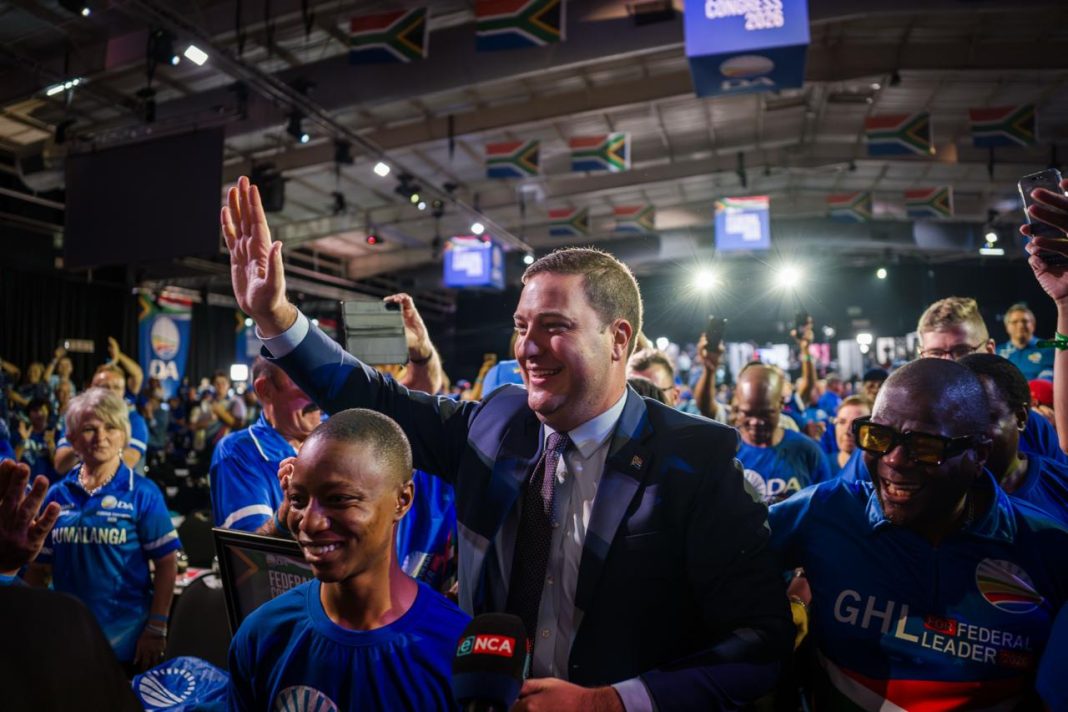
City of Cape Town mayor Geordin Hill-Lewis was elected the new Federal Leader of the Democratic Alliance (DA) at the party’s congress in Johannesburg on Sunday, marking a generational shift.
Hill-Lewis secured victory in a closely watched contest against Sedibeng leader Sibusiso Dyonase, as delegates concluded voting on the second day of the congress.
In his first remarks after being elected, Hill-Lewis struck a conciliatory tone, praising his opponent and signalling unity within the party.
“I want to start by honouring my fellow candidate, Sibusiso, this is a rising star in the DA. There should be absolutely no hard feelings between contestants against each other in our party. We want the best for one another. I want you to succeed, brother,” he said.
The election ushers in a new top leadership collective within the DA.
DA Gauteng leader Solly Msimanga was elected as the party’s Federal Chairperson, while Basic Education Minister Siviwe Gwarube was elected First Deputy Federal Chairperson.
Former Tshwane mayor Cilliers Brink secured the position of Second Deputy Federal Chairperson, and Minister of Communications and Digital Technologies Solly Malatsi was elected Third Deputy Federal Chairperson.
In additional leadership outcomes, Mark Burke was elected Federal Finance Chair, while Ashor Sarupen was chosen as Chairperson of the Federal Council.
Supporting roles in the Federal Council were filled by JP Smith as First Deputy Chairperson, Thomas Walters as Second Deputy Chairperson, and Carl Pophaim as Third Deputy Chairperson.

In his acceptance speech, Hill-Lewis emphasised humility, duty, and a renewed mission to grow the party into a national governing force.
“I accept this responsibility with humility, with gratitude and with a deep sense of duty. However long I have the privilege of serving in this job, I will be dedicated to the mission of building a stronger South Africa for everyone,” he said.
He framed his leadership around the belief that South Africa’s future can be reclaimed through effective governance and political renewal.
“South Africa is worth it. We have a great country and we are a great people, we love this country way too much to see it fail,” he said.
A central theme of his speech was the evolution of the DA, tracing its roots from the Progressive Party through to its modern form, while paying tribute to past leaders including Helen Suzman, Tony Leon, Helen Zille, Mmusi Maimane, and outgoing leader John Steenhuisen.
Hill-Lewis credited each with shaping the party into both a strong opposition and a governing force, arguing that the next phase is to lead the country.
“The question is whether the DA can lead South Africa, whether we can become the largest party in national government. And let me tell you, as your newly elected leader, my answer is a resounding yes,” he said.

He outlined four strategic priorities for achieving that goal: demonstrating effective governance where the DA is in power, expanding support among new voters, acting as a principled partner in the Government of National Unity (GNU), and promoting optimism about South Africa’s future.
Hill-Lewis also placed strong emphasis on crime as the country’s most urgent challenge, describing it as a barrier to economic growth and social stability.
“Bringing law and order to South Africa must be our top priority… we must take back our streets, restore faith in our criminal justice system, and break the criminal syndicates,” he said.
He further stressed that the DA must deepen its presence in communities and build trust “conversation by conversation”, while maintaining its identity as a party capable of delivering governance.
The newly elected leader also signalled the DA’s long-term ambition to move beyond coalition participation and ultimately lead the national government.
“I am not satisfied with being a junior partner in a government of national unity. Our ambition must be to lead the national government,” he said.


INSIDE POLITICS



