



By Thapelo Molefe
The ANC has suffered its worst electoral performance in South Africa’s democratic era, losing almost 15 percentage points of national support as the 2026 Local Government Elections produced a fragmented political landscape, with the uMkhonto weSizwe Party (MKP) emerging as the country’s third-largest political party.
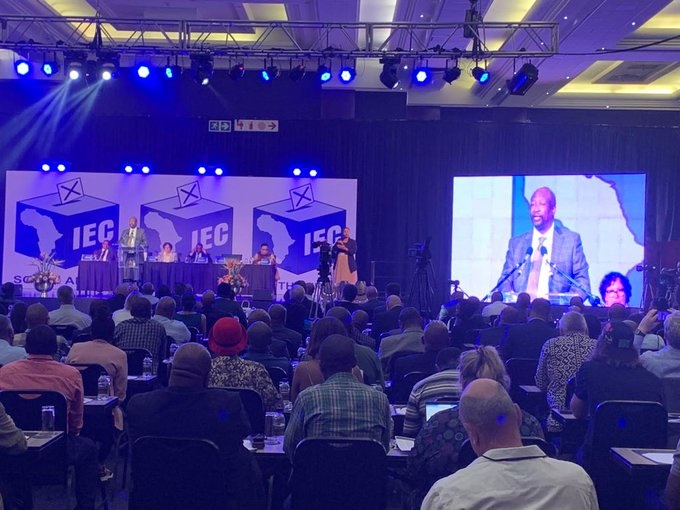
The final results, announced by the Electoral Commission of South Africa (IEC) on Sunday showed the ANC securing 30.76% of the national vote, down from 45.59% in the 2021 local elections.
The decline of 14.83 percentage points marks a historic low for the governing party, which nevertheless remained South Africa’s largest political party.
The DA finished second with 24.64%, an increase from 21.66% in 2021, while the MKP, which did not contest the previous municipal elections, secured approximately 9.76% in its first local government election.
The EFF received 6.22%, down from 10.31%, while ActionSA increased its support to 5.67%, compared with 2.33% five years ago.
The IFP secured about 4.69%, down from 5.64%, while the Patriotic Alliance (PA) increased its share to 1.98%, compared with 0.97% in 2021.
In the combined ward and municipal proportional-representation ballots, the ANC received about 9.16 million votes, compared with 10.70 million in 2021, representing a decline of about 1.54 million votes.
The DA increased its votes from about 5.08 million to 7.34 million, gaining about 2.26 million votes.
The MKP secured approximately 2.91 million votes, while the EFF’s support fell from about 2.42 million to 1.85 million, a decline of approximately 568,000 votes.
ActionSA recorded one of the largest increases in votes, rising from approximately 548,000 to 1.69 million, a gain of about 1.14 million.
The IFP increased its votes from about 1.32 million to 1.40 million despite losing percentage support, while the PA grew from approximately 227,000 to 588,000 votes.
These figures represent combined ward and municipal proportional-representation votes rather than individual voters, who cast separate ballots in municipal elections.
Hung councils increase dramatically
The results have significantly increased the number of municipalities requiring coalition arrangements, with the ANC losing outright majorities in numerous councils.
There were about 127 hung councils out of 212 councils, compared with 70 following the 2021 elections.
The latest council allocations indicated that the ANC had secured outright majorities in 53 municipalities, while the DA had secured 12, the IFP five and the MKP three.
The ANC also remained the leading party in more municipalities than any of its rivals, despite losing considerable ground nationally.
The figures remain subject to final reconciliation, particularly because of an outstanding voting-station result in Siyancuma Municipality in the Northern Cape.
Although the ANC retained the largest share of council seats nationally, the results mean it will have to negotiate coalition or other governing agreements in substantially more municipalities.
Coming first in a municipality does not automatically entitle a political party to the mayoralty. In councils where no party has an outright majority, councillors must elect political leaders through the prescribed voting processes, potentially requiring support from other parties.
Voter turnout increases
The IEC also confirmed that voter participation had increased compared with the previous local government elections.
Turnout reached approximately 52.3%, compared with 45.9% in 2021, an increase of about 6.4 percentage points.
Approximately 15.2 million South Africans participated in the elections, according to IEC chief electoral officer Sy Mamabolo, from a voters’ roll containing about 29.2 million registered voters.
Mamabolo said the commission deployed approximately 188,000 electoral personnel across 23,696 voting stations nationwide.
The IEC also expanded its technological infrastructure, bringing an additional 16,000 voter management devices into operation and increasing its total deployment to approximately 56,000.
The commission recorded 1,149 registered users on the virtual platform, while approximately 54,908 information requests were processed through the system.
Mamabolo said the IEC also received approximately 14.3 million requests for information through its application programming interface, which provided election results to political parties, media organisations and other stakeholders.
IEC declares elections free and fair
IEC chairperson Mosotho Moepya said the commission was satisfied that the elections had been conducted freely and fairly, largely in a peaceful environment.
“The Commission has done this and is satisfied that the 2026 Local Government Elections are indeed, free and fair,” Moepya said on Sunday.
The commission’s assessment was supported by the 2026 Election Satisfaction Survey conducted by the Human Sciences Research Council (HSRC).
The survey found that 90% of voters regarded the electoral procedures as free, while 91% considered them fair.
A further 95% expressed satisfaction with IEC services, while 81% said they trusted the commission.
The HSRC conducted 13,198 face-to-face interviews at 300 voting stations across all nine provinces.
Although the findings reflected widespread satisfaction with the administration of the elections, trust in the IEC declined from 89% in 2021 to 81% in 2026.
Moepya acknowledged that concerns about intimidation, impartiality, inclusive voting and gaps in access to electoral information required further attention.
The commission also confirmed that a voting station in Ward 3 of Siyancuma Municipality, Northern Cape, remained subject to a disputed electoral process after ballot papers were destroyed before counting.
The affected station was identified in IEC results data as Bongani Community Hall in Douglas.
Moepya said the commission had approached the Electoral Court and registered a criminal case with the South African Police Service following the incident.
The IEC also confirmed that it would continue adjudicating objections received after the election in accordance with the Local Government: Municipal Electoral Act.
Mamabolo acknowledged that the administration of the elections had not been without shortcomings.
“We have succeeded in many aspects in this election but we have come short in others,” he said.
INSIDE POLITICS






