



By Johnathan Paoli
Political parties are weighing possible coalition arrangements as early local government election results point to declining ANC support and the prospect of more hung councils across South Africa.
The ANC remained the leading party nationally on Thursday, with 32% of votes captured on the IEC dashboard, followed by the DA on 26.93% and the MKP on 7.14%, as counting continued following Wednesday’s elections.
The latest available figures showed the ANC had secured 785 council seats, compared with 469 for the DA and 103 for the MKP. The EFF had 59 seats and 5.75% of the vote, while ActionSA stood at 3.83%, the VF Plus at 3.74%, the IFP at 3.61% and the Patriotic Alliance at 3.16%.
The results remained provisional, with thousands of voting districts still to be finalised.
The ANC’s early national support was substantially below the approximately 46% it secured in the 2021 local government elections, although the final extent of its losses will only become clear once counting is completed.
READ: ANC narrowly leads DA nationally as early election results show major losses in Joburg
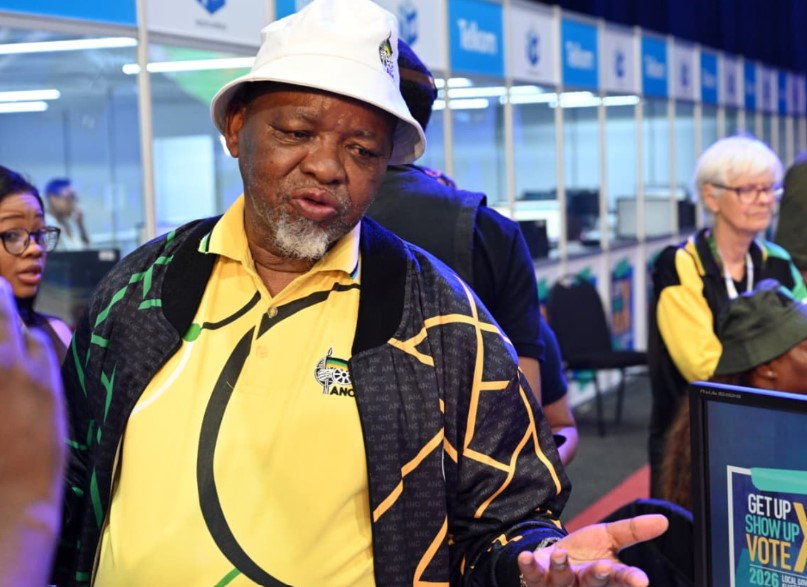
Speaking at the national results operations centre in Midrand on Thursday, ANC national chairperson Gwede Mantashe defended the party’s democratic record despite its declining electoral support, saying the growth of opposition parties reflected the freedoms the ANC had fought to establish.
“We fought for freedom, and freedom is the right to associate and dissociate. And we see that in action. Others are doing it for benefit. Others are doing it because they think they can do better. Others have different reasons. But we’ve given them that freedom. We don’t regret that. A democracy that is maturing is a good democracy,” Mantashe said.
He acknowledged that several factors could explain the ANC’s performance, suggesting that voters were increasingly looking for alternatives after years of supporting the governing party.
“There are many factors. One factor is that when you are in a journey for a long time, you always hope that something new will help you. It happened many years ago to other people. They think that they have travelled, and they think that something new will change,” he said.
Mantashe maintained that the ANC remained an influential political force and defended the decision not to announce mayoral candidates ahead of the elections, arguing that it was intended to encourage candidates to campaign collectively for the ANC rather than focus on individual political ambitions.
READ: ANC made ‘no difference’: Joburg voters demand service delivery, accountability
The decision followed concerns about internal divisions and the possibility that unsuccessful mayoral contenders and their supporters could withdraw support from the party’s election campaign.
Responding to questions about criticism of service delivery, including comments by ANC leaders about potholes and Johannesburg’s municipal crisis, Mantashe refused to be drawn into what he described as “negativity”, saying the party needed to preserve its integrity regardless of the outcome.
Meanwhile, IFP eThekwini mayoral candidate Mkhuleko Hlengwa warned against drawing conclusions from the early results, pointing out that rural municipalities had yet to report significant numbers of votes.
He said proportional representation (PR) seats would be particularly important in determining the eventual composition of municipal councils, alongside ward results.
“What should we be looking out for in the next couple of days? Well, we have to look out for the rural municipalities, which really tend to come in late. And that will change the picture quite fast,” Hlengwa said.
On the prospect of coalition governments, he indicated that the IFP would not enter into arrangements simply to secure political positions, warning that instability could undermine municipal governance.
“We are not prepared to govern at all costs, which means if there’s no clear path forward, which is practical, in account of the rights to participate in governance, then we’ll accept the fate that you must be in the opposition benches. And we do this to avoid the instability which has been characterised in the city of the revolving door. And because of the fact that there’s no clarity in the negotiations, in the priorities,” he said.
Hlengwa said the IFP would draw on its experience in coalition politics and prioritise its manifesto commitments, adding that clear governing priorities would be essential to achieving stability.
READ: Zille says DA won’t enter coalition government ‘just for the sake of being in power’
Al Jama-ah president and deputy Social Development Minister Ganief Hendricks expressed satisfaction with his party’s efforts to expand beyond its traditional strongholds in KwaZulu-Natal, the Western Cape and Gauteng.
He claimed the party had made inroads into the Eastern Cape, North West and Free State, where it had previously struggled to establish a presence, and predicted that it would secure additional proportional representation and ward seats.
“So that is seven out of the nine provinces. We still don’t have a presence in Northern Cape. And then Limpopo. We’ve never had a presence there but we are going to win at least one ward and two PR seats. It’s a very good entry into Limpopo,” Hendricks said.
These projections had yet to be confirmed by the IEC.
Hendricks also identified Madibeng municipality in North West as a possible coalition opportunity, suggesting that an Al Jama-ah ward councillor could put himself forward for the mayoral position once the results had been verified.
He expressed disappointment at voter participation, saying he had expected more South Africans to cast their ballots despite the IEC’s efforts to encourage registration and voting.
The IEC said on Thursday that about 15.9 million South Africans had participated in the elections, including special voters, but cautioned that the final turnout percentage could only be established once counting was completed.
RISE Mzansi chief organiser and head of campaigns Makashule Gana said his party would assess its performance and return to campaigning ahead of the 2029 national and provincial elections.
On coalition negotiations, Gana said RISE Mzansi had not ruled out working with any political formation, insisting that service delivery should determine potential partnerships.
“There will be a lot of municipalities that will be under coalition so we will see when the results come in to see which of the political parties we can work with. We have not drawn a red line on anyone because what we must at all times place at the centre is the interest of the municipalities, the interest of South Africa,” he said.
Gana said coalitions should be judged on their ability to deliver water, collect refuse, maintain roads and keep municipal streets clean, rather than on “political convenience”.
He described voter participation as encouraging, although he hoped turnout would be higher, and said the age breakdown of voters would offer important insights into future electoral trends.
Gana also called for improvements to the IEC’s use of technology, particularly to prevent voters from arriving at incorrect voting stations following boundary changes.
Asked about the ANC’s performance in Soweto, where early results suggested the party was facing electoral pressure, Gana offered a blunt assessment.
“The people have spoken. The people have spoken.”
He said RISE Mzansi would not dwell on results that could no longer be changed but would analyse its performance and return to the campaign trail.
INSIDE POLITICS






